
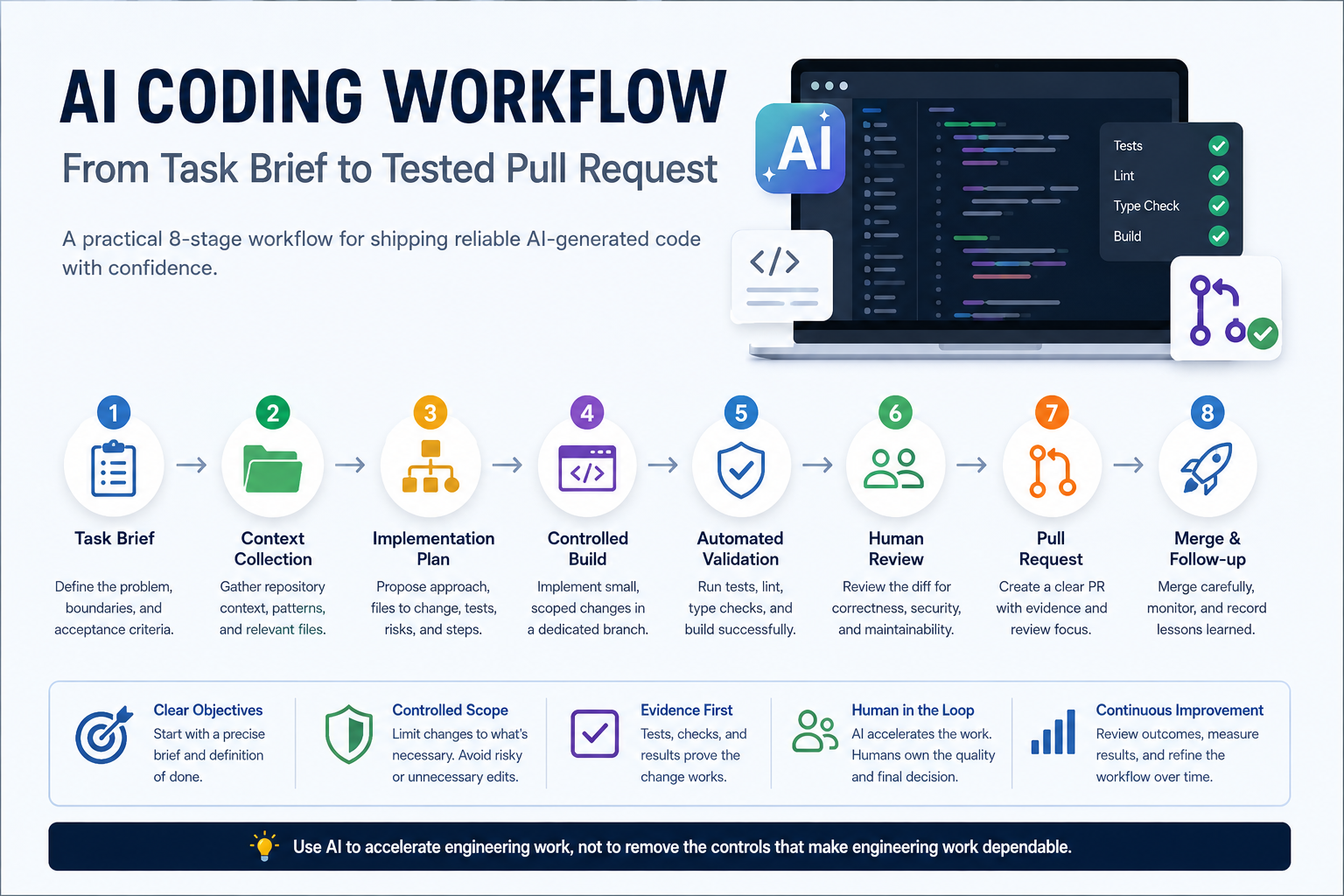
An effective AI coding workflow does not begin with “write the code.” It begins with a clear task brief, defined boundaries, repository context, acceptance criteria, and a test plan. The AI can then propose a solution, implement a controlled change, run validation, and prepare a pull request that a human can review with confidence.
The goal is not to let an AI coding agent make unlimited changes. The goal is to create a repeatable path from a business or engineering request to a small, tested, reviewable pull request.
What you will build
A practical eight-stage AI coding workflow covering task definition, repository context, implementation planning, code generation, automated testing, human review, and pull request handoff.
Best for
Developers, technical founders, small engineering teams, freelancers, and operators using AI coding assistants or autonomous coding agents.
What is an AI coding workflow?
An AI coding workflow is a controlled sequence that defines how an AI assistant receives a task, inspects the codebase, proposes a plan, edits files, validates the result, and hands the work back for review.
It replaces an unreliable one-shot prompt such as:
Build the new dashboard feature and fix any related bugs.with a structured process that answers five questions before implementation begins:
- What problem are we solving?
- Which files and systems may change?
- Which files and behaviors must not change?
- How will we know the result is correct?
- What evidence must accompany the pull request?
The workflow is tool-independent. It can be used with an IDE assistant, a terminal-based coding agent, an asynchronous cloud agent, or a conversational model that generates patches for a human developer.
Why prompt-to-code workflows fail
Most failures attributed to AI-generated code begin before the model writes a line of code. The task is vague, the repository context is incomplete, or success has not been defined.
A coding agent may produce code that looks reasonable while still:
- Changing more files than the task requires.
- Duplicating a utility that already exists.
- Ignoring repository conventions.
- Passing the happy path while failing edge cases.
- Breaking backwards compatibility.
- Introducing a dependency that the team did not approve.
- Editing configuration, permissions, or workflows unnecessarily.
- Claiming completion without running the relevant tests.
The solution is not a longer prompt filled with general instructions. The solution is a workflow with checkpoints, evidence requirements, and explicit stop conditions.
The eight-stage AI coding workflow
| Stage | Primary output | Human decision |
|---|---|---|
| 1. Task brief | Clear problem and acceptance criteria | Is the task ready? |
| 2. Context collection | Relevant repository map | Is important context missing? |
| 3. Implementation plan | Proposed files, steps, and risks | Should implementation begin? |
| 4. Controlled build | Small, scoped code changes | Did the agent exceed scope? |
| 5. Automated validation | Tests, lint, type checks, and build results | Is the evidence sufficient? |
| 6. Human review | Reviewed diff and risk assessment | Is the change correct and maintainable? |
| 7. Pull request | Reviewable PR with evidence | Is it ready for approval? |
| 8. Merge and follow-up | Controlled release and monitoring | Did the change behave correctly? |
Stage 1: Turn the request into an implementation-ready task brief
The task brief is the control document for the entire workflow. It should be understandable without relying on a long chat history or undocumented assumptions.
A useful task brief contains seven parts.
1. Problem statement
Describe the current problem from the user or system perspective.
Users can create saved reports, but they cannot rename them after creation. They currently have to delete the report and recreate it.2. Desired outcome
Add a rename action that allows an authorized user to change a saved report's title without changing its filters, ownership, or identifier.3. Acceptance criteria
- An authorized user can rename a report from the report menu.
- The new title must contain between 3 and 80 characters.
- Leading and trailing whitespace is removed.
- Unauthorized users receive the existing permission error.
- The report ID, filters, owner, and timestamps remain correct.
- The change is covered by automated tests.
4. Out-of-scope items
- Changing report ownership.
- Adding report folders.
- Redesigning the full report page.
- Changing the database identifier.
- Adding a new third-party package.
5. Constraints
- Use the existing authorization system.
- Reuse the current modal and validation patterns.
- Do not modify production infrastructure.
- Do not expose secrets or private customer data to the model.
6. Validation requirements
- Run the relevant unit tests.
- Run the repository’s lint and type-check commands.
- Confirm the production build succeeds.
- Document any test that could not be run.
7. Definition of done
The task is complete only when the implementation, automated tests, documentation, and pull request summary are ready for human review.
Stage 2: Give the AI the smallest useful context
More context is not automatically better. Dumping the entire repository into a conversation can increase noise, cost, and the chance that the agent follows an irrelevant pattern.
Start with a compact repository context packet:
- The task brief.
- The repository instructions file.
- The relevant directory tree.
- The main implementation files.
- Existing tests for the same feature area.
- One or two examples of similar approved code.
- The commands used for testing, linting, type checking, and building.
- Known architectural or security constraints.
Ask the agent to inspect the repository before proposing changes. It should identify existing patterns, shared utilities, validation rules, and tests rather than inventing a parallel implementation.
Repository discovery prompt
You are preparing to implement the task below.

Before writing code:

1. Inspect the relevant directories and existing tests.
2. Identify the current architecture and conventions.
3. Find similar features or reusable utilities.
4. List the files that are likely to change.
5. List any files that appear relevant but should not change.
6. Identify missing information, ambiguity, and risks.
7. Do not edit files yet.

Task brief:
[PASTE TASK BRIEF]

Return:
- repository findings
- relevant files
- reusable patterns
- open questions
- likely risks
This discovery stage is also a good place to apply the principles from the AI Privacy Review Checklist. Remove credentials, production data, private customer information, and unnecessary secrets before giving repository context to an external service.
Stage 3: Require an implementation plan before code
The plan is the first major review checkpoint. It gives the human reviewer a low-cost opportunity to stop a poor approach before it becomes a large diff.
A useful implementation plan should include:
- The proposed solution in plain language.
- The files to create, edit, or delete.
- The role of each changed file.
- Data model or API changes.
- Validation and authorization behavior.
- Tests to add or update.
- Potential backwards-compatibility concerns.
- Questions that require a human decision.
Planning prompt
Using the approved task brief and repository findings, create an implementation plan.

Requirements:

- Prefer the smallest change that satisfies the acceptance criteria.
- Reuse existing patterns and utilities.
- Do not add dependencies unless explicitly approved.
- Do not change unrelated files.
- Include tests and validation steps.
- Identify security, privacy, migration, and compatibility risks.
- Stop and ask questions if an important assumption remains unresolved.

Return the plan as:

1. Proposed approach
2. Files to change
3. Implementation steps
4. Tests to add or update
5. Commands to run
6. Risks and rollback considerations
7. Open questions
Review this plan as if it were a small design proposal. Reject it when it adds unnecessary abstractions, crosses unclear boundaries, or cannot explain how correctness will be tested.
Stage 4: Implement in small, reversible checkpoints
Once the plan is approved, ask the agent to work in a dedicated branch and keep the change narrowly scoped. Large mixed changes are harder to test, harder to review, and harder to reverse.
A useful implementation sequence is:
- Add or update the failing test that represents the desired behavior.
- Make the smallest implementation change needed to satisfy that test.
- Run the focused tests.
- Inspect the diff.
- Refactor only when the behavior is proven.
- Run the broader validation suite.
- Prepare the pull request evidence.
Controlled implementation prompt
Implement the approved plan.

Operating rules:

- Work only in the approved files unless a new dependency is discovered.
- If another file must change, explain why before editing it.
- Preserve existing public behavior unless the task explicitly changes it.
- Do not add packages, modify CI workflows, change permissions, or edit secrets.
- Add or update tests alongside the implementation.
- Run focused validation after each meaningful checkpoint.
- Keep a log of files changed and commands run.
- Stop if the task requires a product, architecture, security, or data decision that was not approved.
The agent should not silently “clean up” nearby code. Unrelated refactoring creates review noise and can hide regressions inside a feature change.
Stage 5: Require evidence, not a claim that the code works
“Tests pass” is incomplete unless the pull request records which tests ran, which commit they validated, and whether any checks were skipped.
The validation stack should match the repository, but a typical sequence includes:
- Focused unit or component tests.
- Integration tests for connected systems.
- Linting and formatting checks.
- Static analysis or type checking.
- Application build.
- Security or dependency checks.
- Manual verification of the acceptance criteria.
Minimum test matrix
| Test type | What it should prove | Evidence in the PR |
|---|---|---|
| Happy path | The requested behavior works | Passing test or reproducible result |
| Invalid input | Validation rejects bad data correctly | Negative test cases |
| Authorization | Unauthorized users cannot perform the action | Permission test |
| Boundary cases | Limits, empty values, and unusual states are handled | Edge-case tests |
| Regression | Existing behavior still works | Relevant existing suite |
| Build and static checks | The change remains compatible with repository standards | Command output or CI result |
AI-generated tests also require review. A test can pass while proving the wrong behavior, mocking away the important logic, or repeating the implementation instead of testing an observable outcome.
Test review prompt
Review the tests added for this change.

Check whether they:

- map directly to the acceptance criteria
- cover invalid input and authorization failures
- include realistic edge cases
- test observable behavior rather than internal implementation details
- would fail if the new feature were removed
- avoid excessive mocking
- avoid duplicating the production logic inside the test
- preserve relevant regression coverage

List weak tests, missing cases, and false-confidence risks. Do not modify the code yet.
Stage 6: Review the diff as if the AI were an unfamiliar contributor
Human review should not be reduced because an AI produced the change. The reviewer remains responsible for deciding whether the code is correct, secure, understandable, and appropriate for the repository.
Review the pull request in layers.
Layer 1: Scope
- Does every changed file support the task?
- Did the agent alter unrelated formatting or code?
- Were new dependencies, permissions, or workflows introduced?
- Is the diff larger than the approved plan predicted?
Layer 2: Behavior
- Does the implementation satisfy every acceptance criterion?
- Are error states and partial failures handled?
- Does the change preserve existing behavior?
- Are validation and authorization enforced server-side where necessary?
Layer 3: Security and data
- Can users access data outside their authorization scope?
- Is untrusted input validated and encoded correctly?
- Are secrets, tokens, or personal data exposed in code or logs?
- Could the change create injection, path traversal, or unsafe command execution risks?
- Were CI, deployment, or permission files modified?
Layer 4: Maintainability
- Does the code follow existing repository conventions?
- Are names clear and responsibilities appropriately separated?
- Is complexity justified by the task?
- Will another developer understand why the change exists?
An AI reviewer can provide an additional pass, but it should not be treated as the final approval authority. Use it to find suspicious areas, missing cases, and inconsistent patterns, then verify each finding manually.
Independent review prompt
Act as an independent pull request reviewer.

Do not assume the implementation is correct.

Compare the diff with the task brief and acceptance criteria. Identify:

1. unmet requirements
2. unrelated scope changes
3. logic errors
4. security and privacy risks
5. missing validation
6. missing or weak tests
7. backwards-compatibility concerns
8. unnecessary complexity
9. repository convention violations
10. claims in the PR description that are not supported by evidence

Classify each finding as:
- blocking
- important
- optional

For every finding, cite the relevant file and explain the failure scenario.
For repeatable evaluation of AI-generated output, use the structure described in the AI Prompt Evaluation Workflow.
Stage 7: Create a pull request that is easy to verify
The pull request is not merely a container for the diff. It is the handoff document between implementation and approval.
A strong AI-generated pull request description should include:
- The problem being solved.
- A concise summary of the approach.
- The files or systems affected.
- The acceptance criteria completed.
- The tests and checks that ran.
- Any validation that remains manual.
- Known limitations and risks.
- Screenshots or recordings for visible changes.
- Migration, rollout, and rollback notes where relevant.
Pull request template
## Problem

[Describe the user or system problem.]

## Solution

[Explain the implementation approach.]

## Scope

Files and systems changed:
- ...

Explicitly out of scope:
- ...

## Acceptance criteria

- [ ] Criterion 1
- [ ] Criterion 2
- [ ] Criterion 3

## Validation

Commands run:
- `...`
- `...`
- `...`

Results:
- ...

Manual checks:
- ...

Not run:
- ...

## Risk assessment

- Security:
- Privacy:
- Compatibility:
- Performance:
- Migration:

## Review focus

Please review:
- ...
- ...

## Rollback

[Explain how the change can be disabled or reverted.]
Important branches should require passing status checks and the appropriate human reviews before merge. The AI can prepare the pull request, but it should not decide that its own work is safe to release.
Stage 8: Merge carefully and monitor the result
A passing pull request does not guarantee that the change will behave correctly in production. Deployment can introduce configuration differences, unexpected data, permissions problems, and interactions that were not represented in tests.
Before merge, confirm:
- The latest commit has passed the required checks.
- The approved diff is the diff being merged.
- No unexpected commit was added after review.
- Migration and rollback instructions are ready.
- Monitoring exists for the affected behavior.
After deployment, monitor the narrow signals connected to the change:
- Error rates.
- Failed requests or jobs.
- Permission failures.
- Latency or resource usage.
- User completion rate.
- Support reports.
Record production findings in the task or pull request. That feedback should improve future task briefs, tests, repository instructions, and review checklists.
Copyable AI coding workflow template
AI CODING WORKFLOW

1. TASK BRIEF
Problem:
Desired outcome:
Acceptance criteria:
Out of scope:
Constraints:
Definition of done:

2. CONTEXT
Relevant directories:
Relevant files:
Existing similar implementation:
Existing tests:
Repository instructions:
Validation commands:
Sensitive information removed:

3. PLAN REVIEW
Proposed approach:
Files to change:
Tests to add:
Risks:
Open questions:
Human approval:

4. IMPLEMENTATION
Branch:
Files changed:
Unexpected scope changes:
Dependencies added:
Commands run:

5. VALIDATION
Focused tests:
Full tests:
Lint:
Type check:
Build:
Security checks:
Manual checks:
Skipped checks and reasons:

6. HUMAN REVIEW
Scope reviewed:
Behavior reviewed:
Security reviewed:
Data handling reviewed:
Tests reviewed:
Maintainability reviewed:

7. PULL REQUEST
Summary:
Acceptance criteria:
Evidence:
Known limitations:
Review focus:
Rollback plan:

8. RELEASE
Required checks passed:
Approval received:
Deployment monitored:
Follow-up issues created:
Quality gates for AI-generated code
| Gate | Pass condition | Stop condition |
|---|---|---|
| Task readiness | Acceptance criteria and boundaries are clear | Important requirements remain ambiguous |
| Plan approval | Proposed change is small and follows repository patterns | Plan introduces unexplained architecture or dependencies |
| Scope control | Diff matches the approved file list | Unrelated files or infrastructure are modified |
| Automated validation | Required tests and checks pass on the latest change | Checks fail, are missing, or were skipped without explanation |
| Human review | Reviewer verifies behavior, security, and maintainability | Review depends only on the AI’s summary |
| Release readiness | Rollback and monitoring are available | Production impact cannot be observed or reversed |
Human review checklist
- Does the change solve the exact problem described in the task brief?
- Can every changed file be explained?
- Did the agent reuse existing repository patterns?
- Were unapproved dependencies avoided?
- Are validation and authorization enforced correctly?
- Are sensitive values absent from code, prompts, tests, and logs?
- Do the tests prove the acceptance criteria?
- Are failure paths and edge cases covered?
- Did the relevant commands run successfully against the latest commit?
- Does the pull request disclose skipped checks and known limitations?
- Can the change be rolled back safely?
- Is a qualified human ready to approve the result?
Common AI coding workflow mistakes
Starting with implementation instead of discovery
The agent invents architecture because it has not inspected the repository. Require discovery and planning before code.
Using vague acceptance criteria
“Make it work” gives neither the AI nor the reviewer a reliable completion test. Define observable behavior, invalid states, permissions, and boundaries.
Allowing unlimited file access and scope
A broad instruction can turn a small feature into a repository-wide refactor. Approve an expected file list and require explanation before the scope expands.
Trusting generated tests automatically
Generated tests may simply confirm the generated implementation. Review whether each test would catch a real regression.
Reviewing the summary instead of the diff
An AI-written summary can omit risky changes or describe intended behavior rather than actual behavior. Inspect the changed files and validation evidence directly.
Merging without a rollback path
Even a small change can fail under production data or configuration. Decide how the change will be disabled, reverted, or corrected before release.
How to implement this workflow in 30 minutes
- Create a reusable task brief template in your issue tracker.
- Add repository instructions describing architecture, commands, and prohibited actions.
- Create a pull request template containing acceptance criteria and validation evidence.
- Protect the main branch with required reviews and status checks.
- Create standard prompts for discovery, planning, implementation, test review, and diff review.
- Test the process on one small, low-risk task.
- Record where the agent needed correction and update the templates.
Do not begin with a production-critical migration or a broad refactor. Start with a small feature or bug fix where the expected behavior is easy to verify.
How to measure whether the workflow is improving
Measure the workflow by review quality and delivery outcomes, not by the number of lines generated.
- Percentage of AI pull requests approved without major rework.
- Average number of review cycles per pull request.
- Percentage of tasks that exceed their approved scope.
- Post-merge defect and rollback rate.
- Percentage of acceptance criteria covered by tests.
- Time from approved task brief to review-ready pull request.
- Frequency of security, privacy, or permission findings.
- Developer time spent correcting avoidable AI errors.
A faster pull request is not an improvement when it creates more review effort, production defects, or hidden maintenance cost.
Frequently asked questions
Should an AI coding agent be allowed to merge its own pull request?
No. The agent that produced the change should not be the final approval authority. Use independent human review and repository protections before merge.
Should every task use the full eight-stage workflow?
The depth can scale with risk. A documentation correction may use a lightweight version, while authentication, payments, infrastructure, and sensitive data changes require the full process.
Can the AI create tests and review its own code?
It can assist with both, but self-review is not independent evidence. Use a separate review pass and human verification, especially for security-sensitive or business-critical behavior.
What should never be included in an AI coding prompt?
Avoid production credentials, private keys, unrestricted tokens, confidential customer data, unnecessary personal information, and internal material the provider is not approved to process.
Which AI coding tool should a team use?
Choose the tool that fits the repository, security model, review process, required integrations, and team workflow. Evaluate it through a controlled pilot rather than selecting only from demonstrations or feature lists. The AI Tool Audit Workflow provides a structured evaluation process.
Final takeaway
A reliable AI coding workflow turns an ambiguous request into a controlled engineering process. The AI receives a clear task brief, inspects the repository, proposes a plan, implements a limited change, produces validation evidence, and prepares a reviewable pull request.
The most important principle is simple: use AI to accelerate engineering work, not to remove the controls that make engineering work dependable.
Related guides
- AI Prompt Evaluation Workflow
- AI Privacy Review Checklist for Automation Projects
- AI Tool Audit Workflow Before Buying Software
- Browse Writoria’s AI Workflow Guides
Official references
- GitHub Docs: About GitHub Copilot cloud agent
- GitHub Docs: About pull requests
- GitHub Docs: Review output from Copilot
- GitHub Docs: Required status checks and repository rulesets
- GitHub Docs: Writing tests with GitHub Copilot