
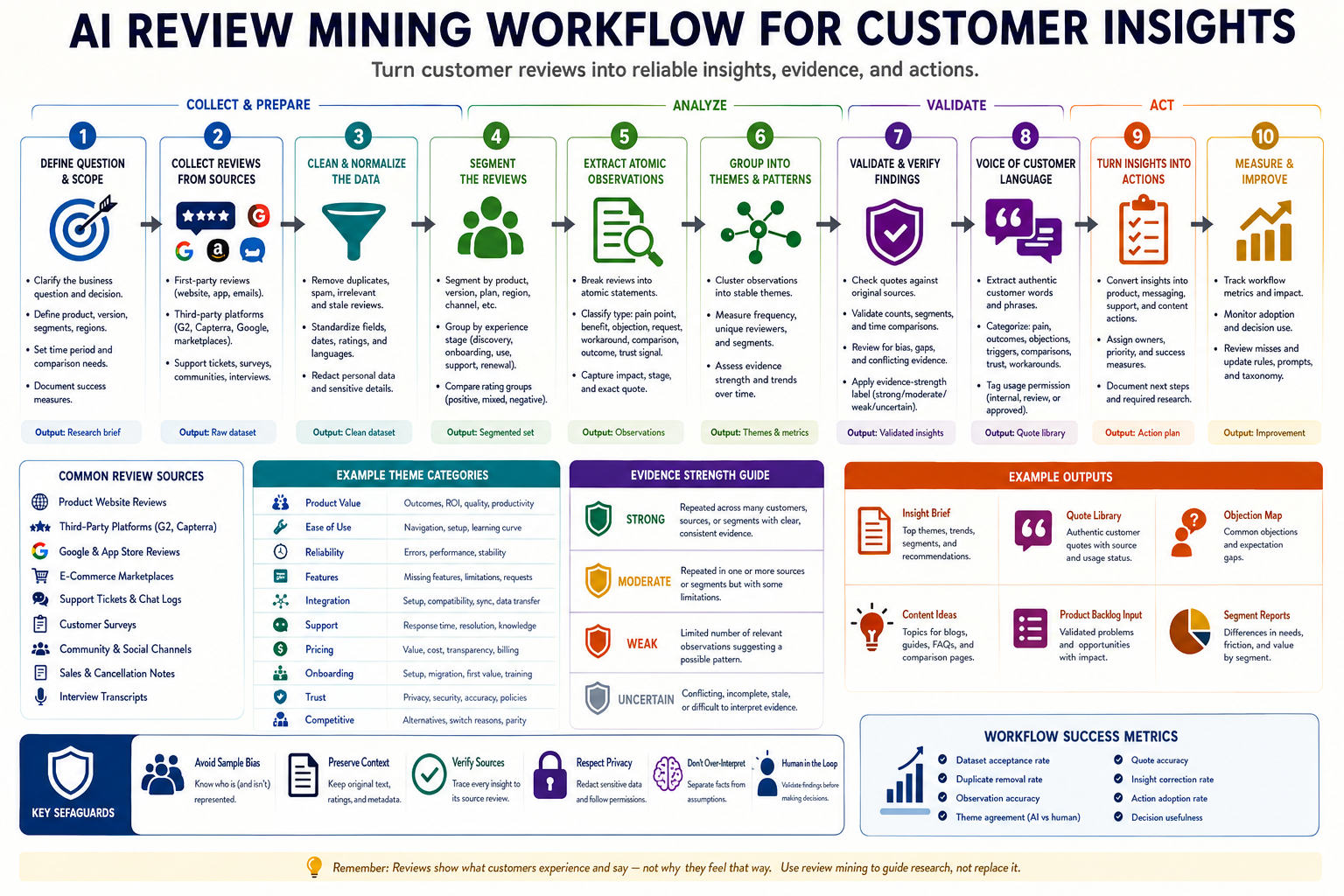
A practical AI review mining workflow turns large collections of customer reviews into structured evidence about pain points, desired outcomes, objections, product strengths, language patterns, and improvement opportunities. It helps product and marketing teams analyze feedback consistently without pretending that every review represents the entire customer base.
The goal is not to let AI produce confident conclusions from a biased sample. The goal is to collect reviews responsibly, preserve their source and context, separate direct evidence from interpretation, validate recurring themes, and convert reliable findings into product, messaging, support, and content decisions.
Why review mining produces misleading insights
Customer reviews are valuable because they contain direct descriptions of expectations, frustrations, outcomes, comparisons, and decision criteria. They are also incomplete evidence. People who leave reviews may be unusually satisfied, unusually disappointed, recently prompted, or influenced by the review platform itself.
Common review-mining failures include:
- Treating review writers as representative of every customer.
- Combining different products, versions, plans, markets, or time periods.
- Analyzing duplicated or syndicated reviews as separate opinions.
- Counting star ratings without reading the written context.
- Using sentiment labels that miss sarcasm, mixed experiences, or conditional praise.
- Combining several separate complaints into one broad theme.
- Presenting an isolated comment as a widespread customer problem.
- Ignoring positive reviews because negative feedback appears more actionable.
- Extracting quotations without preserving their original wording and context.
- Publishing customer language without checking privacy and usage rights.
- Inventing causes that customers did not state.
- Creating product ideas from feedback without checking business value or feasibility.
- Using old reviews to describe the current product experience.
- Reporting theme percentages without explaining the underlying sample.
A dependable workflow should answer:
- Which customers and experiences are represented in the dataset?
- Which repeated needs, pain points, objections, and outcomes appear?
- How strong and diverse is the evidence behind each theme?
- Which words and phrases do customers use naturally?
- What has changed across products, segments, ratings, or periods?
- Which findings deserve action, further research, or no action?
Step 1: Define the customer-insight question
Do not begin by asking AI to “analyze these reviews.” Define the business question first. The research question determines which reviews should be collected, how they should be segmented, and what evidence the final output must contain.
| Research goal | Useful question |
|---|---|
| Product improvement | Which recurring problems prevent customers from completing the intended task? |
| Positioning | Which outcomes do satisfied customers value most? |
| Conversion improvement | Which objections or uncertainties appear before purchase? |
| Onboarding | Where do new users become confused or fail to reach early value? |
| Retention | Which experiences contribute to cancellation, abandonment, or low usage? |
| Content strategy | Which customer questions deserve tutorials, comparisons, or decision guides? |
| Competitive research | Why do customers prefer, switch from, or compare competing products? |
| Support improvement | Which problems repeat because documentation or service processes are unclear? |
Document the following before collecting data:
- Research owner: Who approves the dataset and conclusions?
- Decision supported: What decision may change because of the findings?
- Product scope: Which product, plan, service, or version is included?
- Customer scope: Which segments, regions, or use cases matter?
- Time period: Which review dates are relevant?
- Comparison: Are you comparing periods, products, ratings, or segments?
- Evidence threshold: What makes a theme strong enough to report?
- Output: Insight brief, messaging library, backlog input, or research report?
Step 2: Choose approved review sources
Different sources represent different customer experiences. Public marketplace reviews may emphasize purchase expectations, while support tickets may reveal operational problems after adoption. Preserve each source rather than merging everything into an anonymous text collection.
| Source | Useful evidence | Important limitation |
|---|---|---|
| First-party product reviews | Experience with the product, service, or purchase | Review requests and moderation rules may influence the sample |
| Third-party review platforms | Comparisons, objections, satisfaction, and switching reasons | Reviewer identity and purchase verification may vary |
| Application marketplaces | Version-specific bugs, feature needs, and mobile experience | Reviews may refer to outdated releases |
| E-commerce marketplaces | Product quality, delivery, packaging, and expectation gaps | Seller, shipping, and product issues may be mixed together |
| Customer surveys | Structured satisfaction, needs, and open-ended feedback | Question wording may shape the response |
| Support tickets | Detailed friction, error conditions, and resolution needs | Support users are not the full customer population |
| Sales and cancellation notes | Objections, lost-deal reasons, and retention problems | Internal interpretation may differ from the customer’s exact words |
| Community discussions | Peer language, workarounds, advanced use cases, and questions | A small number of active members may dominate discussion |
| Interview transcripts | Detailed context, motivations, and decision processes | The interviewer’s questions may influence the answers |
Preserve source metadata
Every review should retain enough metadata to support later filtering and verification.
- Source platform
- Review identifier
- Review date
- Collection date
- Product or service
- Product version when available
- Plan or customer segment when authorized
- Rating scale and rating value
- Verified-customer status when available
- Region or language when relevant
- Original review text
- Public or internal usage status
Do not combine reviews from different rating scales without normalizing them. A four-star rating on a five-star platform is not equivalent to four points on a ten-point scale.
Step 3: Check privacy, permissions, and quotation rules
Review mining may involve personal names, account information, purchase details, support history, or sensitive experiences. Use only information required for the research question.
- Remove direct identifiers when they are not required.
- Do not include private support details in public-facing outputs.
- Separate public reviews from confidential internal feedback.
- Do not use a public review as permission to publish unrelated customer information.
- Preserve the original source for internal verification.
- Check whether quotations may be used in marketing or published research.
- Use paraphrases when quotation rights or context are uncertain.
- Limit access to raw reviews containing private information.
- Apply approved retention and deletion rules.
A quotation library should include an explicit usage status such as internal research only, public source requiring review, or approved for publication.
Step 4: Clean and normalize the review dataset
AI analysis becomes unreliable when the dataset contains duplicate, empty, unrelated, machine-translated, or incorrectly attributed records. Clean the data before theme extraction.
| Dataset check | Required action |
|---|---|
| Exact duplicate | Keep one record and preserve all source references |
| Near duplicate | Review whether the same review was syndicated or copied |
| Empty or rating-only review | Keep for rating analysis but exclude from language themes |
| Wrong product or service | Remove from the current analysis scope |
| Old product version | Label separately rather than mixing with the current experience |
| Unclear language | Retain the original and mark for language review |
| Possible spam or manipulation | Exclude or place in a separate verification group |
| Mixed product and delivery complaint | Separate the issues into distinct coded observations |
| Personal information | Remove unnecessary identifiers from the working dataset |
Use one review record per source item
Normalize each usable review into a shared structure:
| Field | Purpose |
|---|---|
| Review ID | Connects findings to the original source |
| Original text | Preserves the customer’s exact statement |
| Clean text | Removes formatting noise without changing meaning |
| Source and date | Supports filtering and freshness checks |
| Rating | Provides the original rating context |
| Product or version | Prevents unrelated experiences from being combined |
| Customer segment | Allows segment-specific analysis when available and authorized |
| Experience stage | Discovery, purchase, onboarding, use, support, renewal, or cancellation |
| Language | Preserves multilingual analysis requirements |
| Quality status | Usable, limited, duplicate, suspicious, or excluded |
Do not rewrite customer wording during cleaning. Correcting grammar or replacing informal language can remove useful voice-of-customer evidence.
Step 5: Segment reviews before drawing conclusions
A theme may be common in one customer group and absent in another. Analyze meaningful segments before describing a finding as universal.
Possible segmentation fields include:
- Product or service
- Product version
- Pricing plan
- Customer type
- Company size
- Industry
- Region or language
- Acquisition channel
- New versus experienced customer
- Rating group
- Purchase, onboarding, usage, support, renewal, or cancellation stage
- Review period
Compare positive, mixed, and negative reviews
Do not analyze only one-star reviews. Positive reviews reveal valued outcomes and decision language, while mixed reviews often reveal the most useful trade-offs.
| Review group | Typical insight |
|---|---|
| Highly positive | Valued outcomes, differentiators, successful use cases, and advocacy language |
| Moderately positive | Benefits with minor friction or missing capabilities |
| Mixed | Trade-offs, conditional satisfaction, and segment-specific limitations |
| Moderately negative | Repeated friction, expectation gaps, and failed workflows |
| Highly negative | Severe failures, broken trust, unresolved support, or unsuitable use cases |
Rating groups should be adapted to the source platform. Preserve the original rating rather than converting every review into a simple positive-or-negative label.
Step 6: Extract atomic observations before themes
One review may contain several independent observations. Split the review into atomic statements before grouping them into themes.
The setup was easy and the reports look good, but importing our historical data took three attempts and support replied after four days.
This review contains at least four observations:
- Setup was easy.
- Report presentation was valued.
- Historical-data import was unreliable.
- Support response was slow.
Combining these into one general “mixed experience” label would hide the actionable details.
Use a consistent observation structure
| Observation field | Purpose |
|---|---|
| Observation | The specific customer statement or experience |
| Type | Pain point, benefit, objection, request, workaround, comparison, or outcome |
| Experience stage | Where the observation occurred in the customer journey |
| Object | Feature, service, process, price, support, documentation, or result |
| Impact | What the experience changed for the customer |
| Evidence quote | The exact supporting phrase |
| Confidence | Explicit, strongly implied, unclear, or conflicting |
| Theme candidate | The possible broader pattern |
Step 7: Build a stable theme taxonomy
A taxonomy prevents AI from creating a new label for every slightly different sentence. Begin with broad categories, then create specific subthemes supported by the data.
| Main category | Possible subthemes |
|---|---|
| Product value | Time saved, quality improved, visibility, convenience, or business outcome |
| Ease of use | Navigation, setup, learning curve, workflow clarity, and accessibility |
| Reliability | Errors, crashes, data loss, performance, and consistency |
| Features | Missing capability, valued feature, limitations, and flexibility |
| Integration | Connection setup, compatibility, synchronization, and data transfer |
| Support | Response speed, resolution, knowledge, communication, and follow-up |
| Pricing | Value perception, affordability, transparency, billing, and plan limits |
| Onboarding | Setup, migration, education, first value, and implementation support |
| Trust | Privacy, accuracy, promises, transparency, and policy confidence |
| Competitive comparison | Reasons for switching, preferred differences, and missing parity |
Do not merge themes only because they use similar words. “Slow application performance” and “slow customer support” both contain the word slow but require different owners and actions.
Track theme evidence separately
| Theme field | Meaning |
|---|---|
| Review count | Number of reviews containing the theme |
| Observation count | Total coded observations connected to the theme |
| Unique reviewer count | Number of distinct reviewers represented |
| Segment distribution | Which customer groups mention the theme |
| Source distribution | Which review sources contain the theme |
| Rating distribution | How the theme appears across rating groups |
| Time trend | Whether the theme is increasing, decreasing, or stable |
| Evidence strength | Strong, moderate, weak, or uncertain |
Review count should usually be based on the number of reviews containing a theme, not the number of times a repeated phrase appears within one review.
Step 8: Separate frequency from importance
A frequent complaint is not automatically the most important problem. A rare issue may cause severe financial, security, accessibility, or trust consequences.
Evaluate themes using several dimensions:
| Dimension | Question |
|---|---|
| Frequency | How many distinct customers mention it? |
| Severity | How strongly does it prevent success or damage trust? |
| Reach | Which segments, products, or journey stages are affected? |
| Trend | Is the issue becoming more common? |
| Business impact | Could it affect conversion, retention, cost, reputation, or risk? |
| Strategic relevance | Does it affect an approved product or market priority? |
| Confidence | How reliable and diverse is the evidence? |
| Actionability | Can the organization realistically improve it? |
Keep these dimensions visible instead of hiding them inside one AI-generated priority score.
Step 9: Extract voice-of-customer language
Customer reviews reveal the words people use to describe problems, desired outcomes, fears, comparisons, and moments of value. This language can support clearer product messaging, documentation, onboarding, and sales conversations.
Useful language categories include:
- Pain language: How customers describe frustration or failure.
- Desired-outcome language: What customers hoped to achieve.
- Value language: How customers describe the benefit they received.
- Objection language: Why customers hesitated or rejected the offer.
- Comparison language: How customers describe alternatives.
- Trigger language: What caused customers to begin searching.
- Trust language: What increased or reduced confidence.
- Workaround language: How customers solved problems outside the intended workflow.
Preserve quotations accurately
Every proposed quotation should include:
- Exact original wording
- Review identifier
- Source
- Date
- Relevant product or segment
- Surrounding context
- Theme connection
- Usage permission status
- Any redaction applied
Do not combine words from several customers into one quotation. A synthesized statement may be useful as an internal summary, but it must not be presented as an authentic customer quote.
Step 10: Analyze objections and expectation gaps
Negative feedback often reflects a difference between what the customer expected and what the product delivered. Separate the type of gap before recommending a response.
| Gap type | Example | Possible response |
|---|---|---|
| Messaging gap | The customer expected a capability not actually promised | Clarify positioning and product-page language |
| Product gap | The required capability is genuinely missing | Evaluate product demand and strategic fit |
| Onboarding gap | The capability exists but customers cannot configure it | Improve setup guidance and education |
| Usability gap | The correct workflow is difficult to discover or complete | Investigate interface and workflow design |
| Support gap | The product issue remains unresolved because help is slow or unclear | Improve routing, documentation, or service standards |
| Fit gap | The customer’s use case is outside the intended product scope | Improve qualification and expectation setting |
| Reliability gap | The promised workflow exists but fails inconsistently | Prioritize technical investigation and verification |
Do not assume every objection requires a product feature. Some findings should improve marketing clarity, customer qualification, education, or support rather than expanding the product.
Step 11: Compare themes across time
Trend analysis can reveal whether an issue is emerging, improving, or tied to a product change. Use equivalent periods and comparable datasets.
- Use the same sources when comparing periods.
- Keep product and rating definitions consistent.
- Document major changes in review volume.
- Separate new product versions from older versions.
- Check whether a campaign increased review requests.
- Use both counts and proportions.
- Flag small samples rather than overinterpreting them.
- Compare unique reviewers, not only total observations.
Example trend record
| Field | Example |
|---|---|
| Theme | Difficulty importing historical data |
| Previous period | 18 of 420 usable reviews |
| Current period | 41 of 460 usable reviews |
| Segment concentration | Most common among customers migrating from Platform B |
| Product change | New import workflow released at the start of the current period |
| Interpretation | The evidence suggests the new workflow may have increased migration friction |
| Confidence | Moderate; support-ticket validation is still required |
Step 12: Validate AI-generated findings
Every important finding should be checked against its source reviews before it enters a product roadmap, campaign, report, or public claim.
- The sample matches the defined research scope.
- Duplicate and suspicious reviews are excluded or clearly marked.
- The theme name accurately represents the underlying observations.
- Evidence examples genuinely support the theme.
- Frequency uses distinct reviews or reviewers consistently.
- The finding is not driven by one unusually active customer.
- Segments with different experiences are not merged.
- Positive, mixed, and negative evidence is represented.
- Facts are separated from hypotheses about causes.
- Quotations match the original wording.
- Time-based comparisons use equivalent datasets.
- Private information is removed from working outputs.
- Publication or marketing usage has the required approval.
Use an evidence-strength label
| Strength | Suggested definition |
|---|---|
| Strong | Repeated across several independent customers, sources, or segments with clear evidence |
| Moderate | Repeated evidence exists but remains concentrated in one source or segment |
| Weak | A small number of relevant observations suggests a possible pattern |
| Uncertain | Evidence is conflicting, incomplete, stale, or difficult to interpret |
Evidence strength should describe confidence in the pattern, not the emotional intensity of the review.
Step 13: Convert insights into decision-ready actions
A review-mining report should not end with a list of themes. Route each validated finding to the team that can investigate or act on it.
| Insight type | Possible action |
|---|---|
| Repeated usability problem | Create a product-research question and usability test |
| Missing feature request | Evaluate affected segments, use cases, and strategic fit |
| Expectation mismatch | Review product pages, sales language, and onboarding |
| Recurring support confusion | Improve documentation and support routing |
| Strong desired-outcome language | Test it in approved positioning and campaign research |
| Repeated objection | Create a decision guide, comparison page, or sales enablement resource |
| Positive product differentiator | Validate it with broader research before emphasizing it |
| Serious reliability or trust issue | Escalate for operational, security, or leadership review |
| Segment-specific limitation | Improve qualification or create segment-specific guidance |
Every action record should include:
- Validated insight
- Evidence strength
- Affected segment
- Customer impact
- Representative evidence
- Recommended investigation or action
- Responsible owner
- Priority decision
- Success measure
- Review date
Recommended review-mining report structure
- Research question: The decision the analysis is intended to support.
- Dataset summary: Sources, dates, products, ratings, segments, and exclusions.
- Sample limitations: Known representation and quality concerns.
- Top valued outcomes: Benefits customers describe repeatedly.
- Top pain points: Friction and failures with evidence strength.
- Objections: Concerns affecting purchase or continued use.
- Expectation gaps: Differences between expected and actual experience.
- Segment differences: Findings that vary by customer group.
- Emerging trends: Themes changing across time.
- Voice-of-customer language: Verified words and phrases.
- Opportunities: Product, support, content, and messaging actions.
- Open questions: Findings that need interviews, analytics, or experiments.
Example customer-insight record
| Field | Example |
|---|---|
| Theme | Historical-data import is difficult to complete |
| Theme type | Onboarding and integration pain point |
| Review count | 41 of 460 usable reviews |
| Primary segment | Customers migrating from another platform |
| Customer impact | Delayed setup and repeated support contact |
| Evidence strength | Moderate |
| Representative language | “We had to restart the import three times before the records matched.” |
| Limitation | Most evidence comes from one review platform |
| Recommended next step | Compare support tickets and observe five migration sessions |
| Owner | Product research lead |
Measure whether the workflow improves customer research
Do not measure success by the number of reviews processed. Measure whether the workflow produces reliable, traceable, and useful evidence.
- Dataset acceptance rate: Percentage of collected reviews approved for analysis.
- Duplicate rate: Percentage removed as exact or near duplicates.
- Observation accuracy: Percentage of extracted observations confirmed by reviewers.
- Theme agreement: Consistency between AI classification and human review.
- Quote accuracy: Percentage of proposed quotations matching the source exactly.
- Evidence traceability: Percentage of findings linked to source reviews.
- Segment coverage: Whether important customer groups are represented.
- Insight correction rate: Percentage of findings materially changed during review.
- Research time: Time required to prepare a validated insight report.
- Action adoption: Percentage of validated findings entering a decision process.
- Outcome validation: Whether later research confirms or rejects the finding.
- Decision usefulness: Whether teams use the evidence to improve a product, message, or process.
Copy-and-use prompts
Review normalization prompt
You are preparing customer reviews for structured analysis.

Research question:
[QUESTION]

Product and version scope:
[SCOPE]

Customer segments:
[SEGMENTS]

Review period:
[PERIOD]

Raw review records:
[PASTE REVIEWS WITH SOURCE METADATA]

For each review, return:

1. Review ID
2. Source
3. Review date
4. Product or version
5. Rating and rating scale
6. Customer segment, only when supplied
7. Experience stage
8. Original review text
9. Quality status:
   - usable
   - rating only
   - duplicate
   - possible duplicate
   - wrong scope
   - stale
   - suspicious
   - requires language review
10. Privacy or permission concern
11. Recommended inclusion decision
12. Human review required

Rules:
- Do not rewrite the customer’s language
- Do not invent customer attributes
- Do not treat rating-only records as text evidence
- Preserve the original source and review ID
- Mark possible duplicates instead of deleting them automatically
- Keep old product versions separate
- Remove unnecessary personal identifiers from the working output
Atomic observation extraction prompt
Extract atomic customer observations from these approved reviews.

Research question:
[QUESTION]

Approved reviews:
[PASTE REVIEWS]

For each distinct observation, return:

1. Review ID
2. Exact supporting quotation
3. Observation in plain language
4. Observation type:
   - pain point
   - valued outcome
   - objection
   - feature request
   - workaround
   - comparison
   - trust signal
   - expectation gap
   - support experience
5. Experience stage
6. Product, feature, or process affected
7. Customer impact
8. Explicit or inferred
9. Confidence:
   - high
   - medium
   - low
10. Candidate theme
11. Missing context

Rules:
- Split reviews containing several independent observations
- Do not invent causes, motives, or business impact
- Do not paraphrase inside the quotation field
- Preserve mixed experiences
- Do not force unclear statements into a theme
- Keep facts and interpretations separate
Theme-building prompt
Group these customer observations into a stable theme taxonomy.

Research question:
[QUESTION]

Segments:
[SEGMENTS]

Observations:
[PASTE ATOMIC OBSERVATIONS]

Create:

1. Main categories
2. Specific subthemes
3. Clear definition for each theme
4. Included examples
5. Excluded examples that may look similar
6. Review count
7. Unique-reviewer count when available
8. Segment distribution
9. Source distribution
10. Rating distribution
11. Representative evidence
12. Conflicting evidence
13. Evidence strength:
   - strong
   - moderate
   - weak
   - uncertain
14. Open research questions

Rules:
- Do not merge themes merely because they share words
- Do not count repeated mentions inside one review as separate customers
- Do not describe isolated observations as widespread
- Keep product, support, pricing, and delivery problems separate
- Preserve segment-specific differences
- Include positive, negative, and mixed evidence
Voice-of-customer language prompt
Extract useful voice-of-customer language from these verified reviews.

Research purpose:
[PURPOSE]

Verified reviews and observations:
[PASTE RECORDS]

Organize the language into:

1. Pain language
2. Desired-outcome language
3. Value language
4. Objection language
5. Comparison language
6. Trigger language
7. Trust language
8. Workaround language

For each phrase, return:

- Exact quotation
- Review ID
- Source
- Date
- Product or segment
- Relevant context
- Theme
- Evidence strength
- Usage status:
  - internal research only
  - requires publication review
  - approved for publication

Rules:
- Do not create synthetic quotations
- Do not combine wording from different customers
- Do not remove wording that changes the meaning
- Do not include private or identifying details unnecessarily
- Do not recommend publication without the required permission
- Exclude generic phrases with no decision value
Customer-insight validation prompt
Review this AI-generated customer-insight report before it is used.

Research question:
[QUESTION]

Dataset summary:
[DATASET]

Source reviews:
[REVIEWS]

Proposed findings:
[FINDINGS]

Check for:

1. Findings outside the defined research scope
2. Duplicate reviews counted as independent evidence
3. Old product versions mixed with the current product
4. Themes based on one reviewer or one source
5. Frequency claims without a clear denominator
6. Segments combined despite different experiences
7. Sentiment labels that miss mixed feedback
8. Unsupported explanations of cause
9. Quotations that do not match the original source
10. Important positive or conflicting evidence omitted
11. Private information included unnecessarily
12. Publication claims without permission
13. Recommendations stronger than the evidence supports
14. Small samples presented as reliable trends

Return:
- Blocking corrections
- Important corrections
- Unsupported findings
- Findings needing more evidence
- Quotes requiring correction or permission review
- Final evidence-strength assessment
- Decision:
  - ready for internal use
  - minor revision
  - major revision
  - additional research required
  - do not use

Do not approve a finding merely because it sounds plausible or actionable.
AI review mining workflow checklist
- The research question and decision owner are defined.
- The product, customer, source, and time scope are documented.
- Review-source limitations are recorded.
- Original review IDs and source metadata are preserved.
- Rating scales are normalized correctly.
- Duplicate, suspicious, stale, and unrelated records are separated.
- Private information is minimized.
- Quotation and publication permissions are checked.
- Customer wording is preserved during cleaning.
- Reviews are segmented before broad conclusions are made.
- Positive, mixed, and negative reviews are included.
- Reviews are split into atomic observations.
- Facts and inferred meanings are separated.
- The theme taxonomy has clear definitions.
- Similar words are not treated as identical themes automatically.
- Frequency uses distinct reviews or reviewers consistently.
- Theme counts include a clear denominator.
- Frequency and severity are evaluated separately.
- Segment and source concentration are visible.
- Time comparisons use equivalent datasets.
- Representative quotations match the original wording.
- Conflicting evidence is preserved.
- Every major finding receives an evidence-strength label.
- A human verifies the findings before decisions are made.
- Actions include an owner, evidence, and success measure.
Common mistakes to avoid
- Analyzing without a research question: Connect the dataset to a specific decision.
- Trusting the review sample: Document who is and is not represented.
- Counting duplicates: Detect syndicated and copied reviews.
- Using sentiment alone: Extract the specific experience and impact.
- Ignoring mixed reviews: Preserve benefits, limitations, and trade-offs.
- Confusing frequency with severity: Evaluate both separately.
- Inventing customer intent: Separate direct evidence from interpretation.
- Creating fake quotations: Preserve exact wording and source records.
- Jumping directly to features: Consider messaging, onboarding, support, and qualification responses.
- Publishing raw findings: Require evidence, privacy, and permission review.
Final guidance
A dependable AI review mining workflow does not turn a collection of opinions into instant customer truth. It creates a traceable process for cleaning reviews, separating observations, identifying repeated patterns, measuring evidence strength, and preserving the language customers use to describe their experiences.
Use AI to organize records, extract observations, group themes, compare segments, and prepare insight drafts. Keep sample interpretation, quotation approval, causal conclusions, product priorities, and final business decisions under human control.
Related guides
- Build an AI Community Management Workflow
- Build an AI Client Report Workflow for Agencies
- Build an AI Decision Brief Workflow for Managers
- Browse Practical AI Workflow Guides