
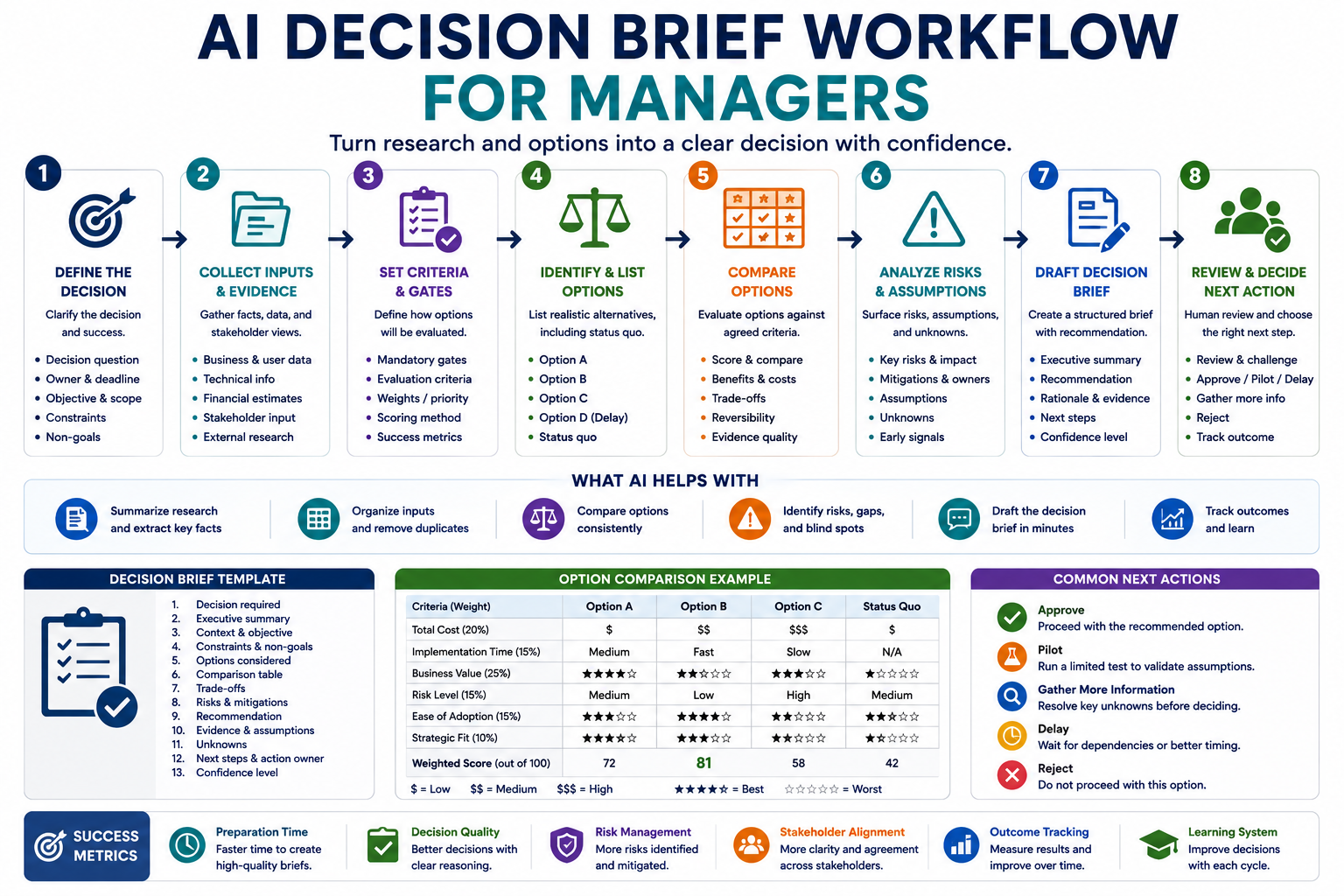
Managers often receive research, opinions, spreadsheets, meeting notes, and competing proposals without a clear way to compare them. An AI decision brief workflow can turn this scattered information into a structured document that explains the decision, available options, trade-offs, risks, assumptions, and recommended next step.
The goal is not to let AI make the decision. The goal is to reduce the time required to organize evidence, expose missing information, compare alternatives consistently, and prepare a brief that a responsible manager can challenge and approve.
When to use an AI decision brief workflow
A decision brief is useful when a manager must choose between several realistic options and the available information is too scattered for a quick comparison.
Common use cases include:
- Selecting a software tool or vendor.
- Choosing whether to build, buy, or delay a capability.
- Prioritizing projects for the next quarter.
- Comparing hiring, outsourcing, and automation options.
- Evaluating a pricing or packaging change.
- Deciding whether to launch a pilot.
- Comparing operational process changes.
- Assessing expansion into a new customer segment.
The workflow is less suitable when the decision is governed by a fixed rule, requires specialist legal or medical judgment, involves confidential information that cannot be shared with the chosen AI tool, or depends on evidence that has not yet been collected.
Step 1: Define the decision precisely
A weak decision question produces a weak brief. Start by writing the decision in a form that identifies the choice, the owner, the deadline, and the intended outcome.
For example, this question is too broad:
Which AI tool should we use?
A stronger version is:
Which approved AI writing tool should the content team pilot for eight weeks to reduce first-draft time without exposing confidential client data or increasing editorial correction rates?
A complete decision definition should include:
- Decision: What choice must be made?
- Decision owner: Who has final authority?
- Deadline: When is the decision required?
- Scope: Which teams, markets, or systems are affected?
- Objective: What result should the decision produce?
- Constraints: Budget, time, policy, security, staffing, or technical limits.
- Non-goals: What is explicitly outside the decision?
Step 2: Collect the evidence and stakeholder input
The workflow should not begin with an unrestricted prompt asking AI what the company should do. It should begin with documented evidence.
| Input type | Examples | Review question |
|---|---|---|
| Business evidence | Cost estimates, revenue impact, workload, delivery time | Is the evidence current and based on a clear method? |
| User evidence | Interviews, support tickets, surveys, usage patterns | Does the evidence represent the affected users? |
| Technical evidence | Architecture constraints, integrations, security findings | Has a qualified technical owner verified it? |
| Operational evidence | Process maps, staffing needs, training requirements | Can the proposed option be maintained after launch? |
| Stakeholder input | Concerns, preferences, dependencies, objections | Is this evidence, judgment, or personal preference? |
| External evidence | Vendor documentation, benchmarks, regulations, market research | Is the source reliable and applicable to this decision? |
Separate confirmed facts from estimates and opinions. The brief should never present a stakeholder preference as verified evidence.
Use evidence labels
- Verified fact: Confirmed by a reliable source or responsible owner.
- Estimate: Based on a stated method but not yet confirmed.
- Assumption: Required for analysis but not supported by evidence.
- Opinion: A stakeholder judgment or preference.
- Unknown: Information that is still missing.
Step 3: Define the decision criteria before comparing options
Do not let the model invent evaluation criteria after seeing which option appears strongest. Criteria should be agreed before scoring alternatives.
Typical decision criteria include:
- Total cost
- Time to implement
- Expected business value
- Security and privacy
- Reliability
- Ease of adoption
- Integration effort
- Operational maintenance
- Vendor dependency
- Reversibility
- Legal or policy compliance
- Strategic fit
Some criteria are mandatory gates rather than scoring factors. For example, a tool that fails a required security review should not remain in the comparison merely because it is inexpensive.
Separate gates from weighted criteria
| Type | Purpose | Example |
|---|---|---|
| Mandatory gate | Removes options that fail a non-negotiable condition | Must support the company’s required data region |
| Weighted criterion | Helps compare acceptable options | Implementation speed weighted at 20% |
| Qualitative consideration | Captures important context that is hard to score | Team trust in the vendor |
Step 4: Compare realistic options
A decision brief should compare more than a preferred proposal against an obviously weak alternative. Include all realistic options, including maintaining the current approach when that remains possible.
- Option A: Proceed with the proposed change.
- Option B: Use a smaller or lower-risk version.
- Option C: Choose a different approach.
- Option D: Delay until a dependency or unknown is resolved.
- Status quo: Continue the current process.
For each option, document:
- Expected benefit
- Cost
- Implementation effort
- Dependencies
- Main risks
- Trade-offs
- Reversibility
- Evidence quality
- Open questions
Do not hide the status quo
Keeping the current process also has costs and risks. The brief should explain the consequences of doing nothing, including delays, lost opportunities, ongoing manual effort, technical debt, or exposure to known problems.
Step 5: Evaluate trade-offs and risks
A useful brief does not present one option as having only benefits. Every realistic choice creates trade-offs.
| Risk field | Question |
|---|---|
| Risk | What could go wrong? |
| Likelihood | How likely is the event? |
| Impact | What happens if it occurs? |
| Early signal | How will the team notice the risk developing? |
| Mitigation | What reduces likelihood or impact? |
| Owner | Who is responsible for monitoring it? |
| Residual risk | What remains after mitigation? |
AI can help organize known risks and identify possible omissions, but a qualified person should verify security, financial, legal, people, and operational consequences.
Step 6: Build the decision brief
The final document should be concise enough for a decision-maker to review, but detailed enough to show how the recommendation was reached.
A practical decision brief contains:
- Decision required: The exact choice and deadline.
- Executive summary: The recommendation and central reason.
- Context: Why the decision is needed now.
- Objectives: The result the organization wants.
- Constraints: Non-negotiable limits.
- Options: Realistic alternatives, including the status quo.
- Comparison: How each option performs against agreed criteria.
- Trade-offs: What is gained and sacrificed.
- Risks: Main risks, mitigations, and owners.
- Recommendation: Preferred option with supporting evidence.
- Confidence: How strong the available evidence is.
- Unknowns: Missing information that could change the recommendation.
- Next steps: Approval, pilot, investigation, or implementation actions.
Keep evidence connected to claims
Every important conclusion should point to the evidence that supports it. Avoid statements such as “Option A is more scalable” without explaining which capacity, process, cost, or technical evidence supports that conclusion.
Step 7: Review the recommendation for bias and missing evidence
AI-generated recommendations can overstate confidence, favor the most detailed option, or repeat assumptions contained in the source material. A human reviewer should challenge the brief before it reaches the decision owner.
- Were the criteria defined before the options were scored?
- Were any realistic options excluded?
- Is the status quo described fairly?
- Are opinions clearly separated from facts?
- Does the recommendation depend on unsupported assumptions?
- Were benefits and costs evaluated using the same standard?
- Are significant risks minimized or omitted?
- Does one stakeholder’s preference dominate the evidence?
- Could new information reverse the recommendation?
- Is the decision owner clear?
Use a confidence rating
- High confidence: Strong evidence, limited unknowns, and consistent results across sources.
- Medium confidence: Reasonable evidence with important assumptions or incomplete data.
- Low confidence: Major unknowns, conflicting evidence, or reliance on unverified estimates.
A low-confidence recommendation may still be useful when the next step is a reversible pilot rather than a full commitment.
Step 8: Choose the appropriate decision action
The output does not always need to be an immediate yes or no. The workflow should recommend the smallest responsible next action.
- Approve: Evidence is sufficient and the option is within acceptable risk.
- Approve with conditions: Proceed only after stated controls or dependencies are completed.
- Run a pilot: Test a reversible version before wider commitment.
- Gather more evidence: Resolve specific unknowns before deciding.
- Delay: Wait for a dependency, budget, or policy decision.
- Reject: The option fails mandatory requirements or creates unacceptable risk.
Example decision brief: choosing a support automation pilot
Assume a small company is deciding whether to pilot AI-assisted drafting for customer support replies.
| Brief section | Example |
|---|---|
| Decision | Whether to run an eight-week AI-assisted reply pilot for the support team. |
| Objective | Reduce first-draft time while maintaining accuracy and customer satisfaction. |
| Constraints | No automated sending, no confidential data in unapproved tools, and mandatory human review. |
| Option A | Continue the current manual process. |
| Option B | Run a limited pilot for low-risk ticket categories. |
| Option C | Deploy AI drafting across all ticket categories immediately. |
| Recommendation | Choose Option B because it tests value while limiting customer and privacy risk. |
| Key unknown | How much editor correction will be required. |
| Success metric | Reduced drafting time without higher correction or escalation rates. |
| Review point | Evaluate results after four and eight weeks. |
Measure the quality of the workflow
Do not measure the system only by how quickly it produces a brief. Track whether the brief helps managers make clearer and more defensible decisions.
- Preparation time: Time required to create the brief.
- Revision rate: How much of the AI draft requires correction.
- Evidence coverage: Percentage of important claims supported by evidence.
- Unknown resolution: Whether missing information is identified early.
- Decision latency: Time between the initial request and final decision.
- Decision reversal: Whether decisions are later changed because important information was missed.
- Stakeholder clarity: Whether participants understand the reason for the decision.
- Outcome tracking: Whether the expected result is measured after implementation.
Copy-and-use prompts
Decision framing prompt
You are helping a manager define a decision before evaluating options.

Initial request:
[PASTE REQUEST]

Business context:
[CONTEXT]

Known deadline:
[DEADLINE]

Known constraints:
[CONSTRAINTS]

Convert the request into a decision definition containing:

1. Exact decision required
2. Decision owner
3. Deadline
4. Objective
5. Scope
6. Non-goals
7. Mandatory constraints
8. Stakeholders affected
9. Evidence required
10. Open questions

Do not recommend an option yet.
Do not invent missing business information.
Clearly label assumptions and unknowns.
Decision brief prompt
Create a structured decision brief from the information below.

Decision:
[DECISION]

Objective:
[OBJECTIVE]

Decision criteria:
[CRITERIA AND WEIGHTS]

Mandatory gates:
[NON-NEGOTIABLE REQUIREMENTS]

Options:
[LIST OPTIONS, INCLUDING STATUS QUO]

Evidence:
[PASTE RESEARCH, COSTS, INTERVIEWS, TECHNICAL INPUT, AND OTHER SOURCES]

Known assumptions:
[ASSUMPTIONS]

Known unknowns:
[UNKNOWNS]

Return:

1. Decision required
2. Executive summary
3. Context
4. Objectives and constraints
5. Options considered
6. Comparison table
7. Trade-offs
8. Risks and mitigations
9. Recommendation
10. Evidence supporting the recommendation
11. Confidence level
12. Assumptions
13. Unknowns that could change the recommendation
14. Smallest responsible next action
15. Human reviewers required

Rules:
- Separate facts, estimates, assumptions, opinions, and unknowns
- Do not invent evidence
- Do not hide weaknesses in the recommended option
- Evaluate the status quo fairly
- State when the evidence is insufficient for a final decision
Decision brief review prompt
Review this decision brief as a skeptical executive reviewer.

Decision brief:
[PASTE BRIEF]

Check for:

1. Unclear decision framing
2. Missing realistic options
3. Unfair treatment of the status quo
4. Unsupported claims
5. Opinions presented as facts
6. Hidden assumptions
7. Inconsistent scoring
8. Missing costs or trade-offs
9. Understated risks
10. Overstated confidence
11. Missing decision owner or deadline
12. Unknowns that could reverse the recommendation

Return:
- Blocking issues
- Unsupported conclusions
- Missing evidence
- Possible bias
- Questions the decision owner should ask
- Recommended confidence level
- Whether to approve, pilot, gather more evidence, delay, or reject

Do not make the final business decision.
Do not invent problems without evidence in the brief.
Post-decision review prompt
Review the outcome of a completed business decision.

Original decision brief:
[PASTE BRIEF]

Decision made:
[DECISION]

Expected outcome:
[EXPECTED RESULT]

Actual results:
[RESULTS]

Time period:
[PERIOD]

Evaluate:

1. Which assumptions were correct
2. Which assumptions were wrong
3. Which risks occurred
4. Which early signals were missed
5. Whether the expected outcome was achieved
6. Whether the decision should continue, change, or stop
7. What should be added to future decision briefs

Return:
- Outcome summary
- Evidence comparison
- Lessons learned
- Required corrective actions
- Updated decision rules
AI decision brief workflow checklist
- The exact decision and decision owner are identified.
- The deadline and intended outcome are clear.
- Mandatory gates are separated from weighted criteria.
- All realistic options, including the status quo, are included.
- Facts, estimates, assumptions, opinions, and unknowns are labeled.
- Important claims are connected to evidence.
- Benefits and costs use consistent comparison standards.
- Trade-offs are stated openly.
- Risks include likelihood, impact, mitigation, and owner.
- The recommendation explains why it is preferred.
- The confidence level reflects evidence quality.
- Unknowns that could change the recommendation are visible.
- A responsible human reviews the brief.
- The smallest appropriate next action is defined.
- The outcome will be reviewed after implementation.
Common mistakes to avoid
- Asking AI to decide immediately: Frame the decision and collect evidence first.
- Comparing only two options: Include the status quo and realistic alternatives.
- Choosing criteria after seeing the results: Define them before scoring.
- Presenting assumptions as facts: Label uncertainty explicitly.
- Hiding disadvantages: Every option has costs and trade-offs.
- Using false precision: Do not turn weak estimates into authoritative scores.
- Ignoring reversibility: A pilot may be better than a permanent commitment.
- Failing to review outcomes: Compare the decision with real results later.
Final guidance
A dependable AI decision brief workflow helps managers organize complex information without transferring responsibility to the model. AI can summarize evidence, compare options, identify unknowns, and draft the document, but a responsible person must verify the evidence and make the final decision.
The strongest briefs make uncertainty visible. They explain what is known, what is estimated, which assumptions matter, what each option sacrifices, and what new evidence could change the recommendation.
Related guides
- How to Build an AI Automation Workflow for Repetitive Tasks
- Build an AI Content Refresh Workflow for Old Articles
- Browse Practical AI Workflow Guides
- Explore Writoria’s AI Automation Guides