
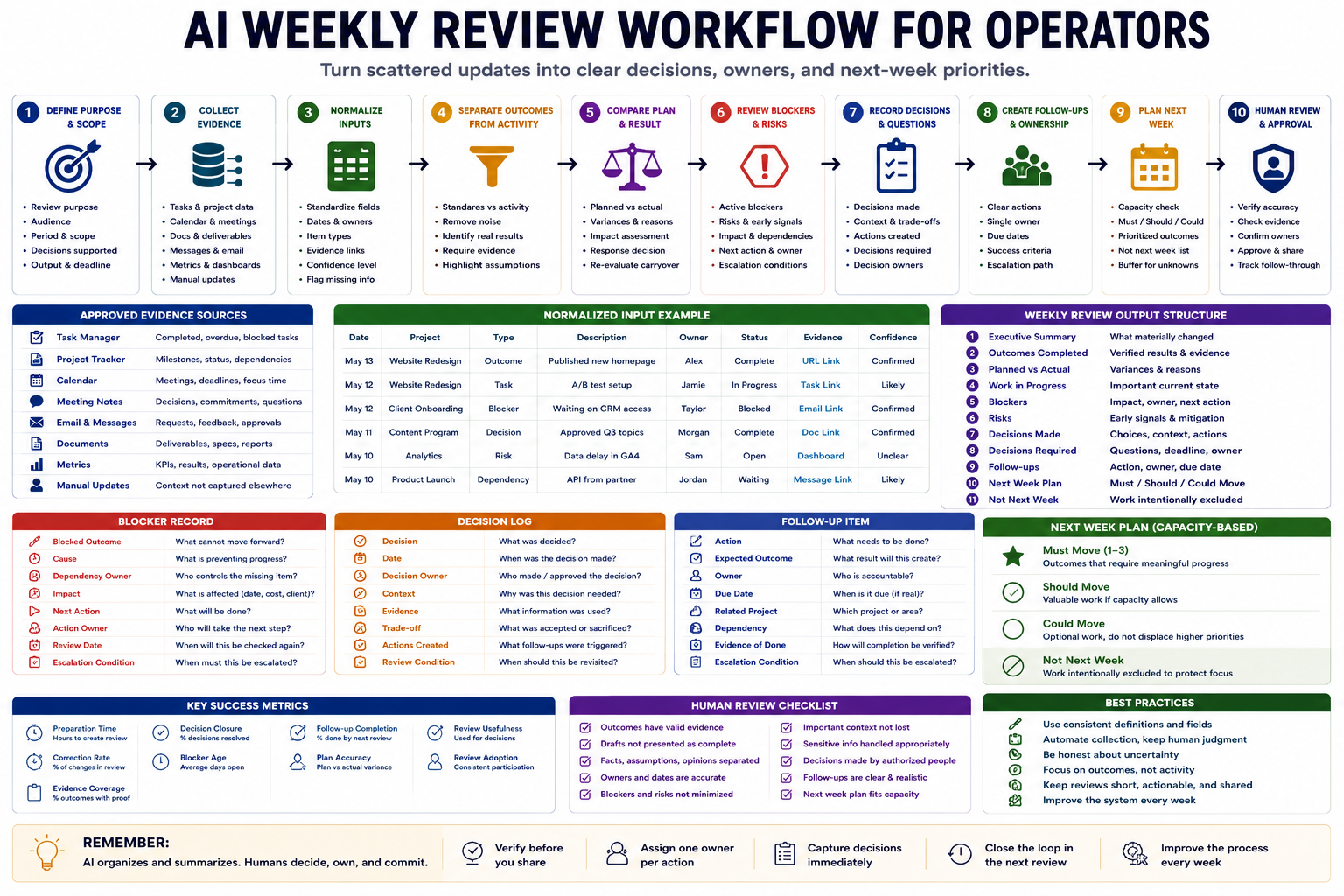
Weekly reviews often become long status summaries that describe activity without helping anyone decide what to do next. A practical AI weekly review workflow should turn scattered project updates, calendar events, tasks, notes, blockers, and commitments into a short operating review with verified outcomes, unresolved decisions, owners, follow-ups, and next-week priorities.
The goal is not to let AI judge team performance or invent progress. The goal is to reduce the time spent collecting and organizing weekly evidence while keeping managers and operators responsible for interpretation, decisions, commitments, and final approval.
Why weekly reviews become unhelpful
A weekly review should help the team understand what changed and what requires action. It becomes unhelpful when it only repeats task lists, meeting notes, or optimistic updates.
Common failure patterns include:
- Reporting activity instead of outcomes.
- Marking work complete without evidence or acceptance.
- Listing blockers without owners or next steps.
- Carrying unfinished tasks forward automatically.
- Mixing facts, assumptions, opinions, and forecasts.
- Ignoring decisions that remain unresolved.
- Assigning actions without named owners or dates.
- Planning the next week without checking capacity.
- Using AI summaries that omit important context.
- Producing a review document nobody uses after the meeting.
A strong weekly review should answer five questions:
- What meaningful outcomes changed this week?
- What did not happen, and why?
- Which blockers, risks, or decisions need attention?
- Who owns each follow-up?
- What can realistically move next week?
Step 1: Define the purpose and audience
Do not collect data before deciding who the review serves and which decisions it should support. A founder review, project review, and team operations review may use similar inputs but require different outputs.
| Review type | Main audience | Primary purpose |
|---|---|---|
| Personal operator review | Solo operator or creator | Evaluate execution, capacity, and next priorities |
| Team operations review | Manager and team members | Resolve blockers, coordinate owners, and manage workload |
| Project review | Project owner and stakeholders | Compare milestones, risks, dependencies, and decisions |
| Founder review | Founder or leadership team | Review business outcomes, constraints, and strategic choices |
| Client delivery review | Account owner and delivery team | Confirm progress, client dependencies, commitments, and risks |
Document the following before building the workflow:
- Review owner: Who prepares and approves the final review?
- Audience: Who reads or discusses it?
- Period: Which dates are included?
- Scope: Which projects, teams, or goals are covered?
- Decisions supported: What should become clearer after the review?
- Output: Document, meeting brief, dashboard note, or action list.
- Deadline: When must the review be ready?
Step 2: Collect weekly evidence from approved sources
The review should use evidence from the systems where work actually happened. Avoid asking people to reconstruct the entire week from memory.
| Source | Useful information | Risk to check |
|---|---|---|
| Task manager | Completed, overdue, reassigned, and blocked tasks | A checked task may not represent an accepted outcome |
| Project tracker | Milestones, status changes, dependencies, and owners | Status labels may be outdated |
| Calendar | Meetings, deadlines, focus blocks, and planned commitments | A calendar event does not prove useful work occurred |
| Meeting notes | Decisions, commitments, objections, and open questions | Notes may contain unconfirmed interpretations |
| Email and messages | Requests, approvals, client feedback, and follow-ups | Important context may be incomplete or sensitive |
| Documents and deliverables | Evidence that an outcome was produced | A draft may be mistaken for a final result |
| Metrics dashboard | Operational, product, sales, or content results | Metrics may use different periods or definitions |
| Manual update | Context that systems do not capture | Updates may be optimistic or unsupported |
Use only approved sources and avoid sending confidential customer, employee, financial, or operational information into an AI tool without the appropriate controls.
Set a collection cutoff
Define when the weekly evidence stops. For example, the review may cover Monday 09:00 through Friday 15:00. A fixed cutoff prevents late updates from changing the report while it is being reviewed.
Step 3: Normalize the inputs before summarization
Information from different tools uses different formats and levels of detail. Normalize each item into a shared structure before asking AI to summarize it.
| Field | Purpose |
|---|---|
| Date | Places the item within the review period |
| Project or workstream | Connects the item with an outcome |
| Item type | Outcome, task, decision, blocker, risk, request, or note |
| Description | States what occurred in plain language |
| Owner | Identifies responsibility |
| Status | Completed, in progress, blocked, waiting, cancelled, or unknown |
| Evidence | Link, document, metric, approval, or source record |
| Due date | Records a real commitment when one exists |
| Dependency | Shows what or whom the work depends on |
| Confidence | Indicates whether the information is confirmed or uncertain |
Do not invent owners, dates, progress percentages, or completion evidence when the source does not provide them. Mark the field as unknown and route it for clarification.
Step 4: Separate outcomes from activity
AI summaries often exaggerate progress by combining meetings, messages, and task updates into a polished paragraph. Require the workflow to separate activity from verified outcomes.
| Activity statement | Outcome-focused statement |
|---|---|
| Held three onboarding meetings | Approved the onboarding workflow and assigned implementation owners |
| Worked on the report | Completed the analysis section; executive summary remains open |
| Reviewed customer feedback | Identified three repeated issues and approved one product change |
| Discussed the campaign | Selected the campaign concept; budget approval is still pending |
| Updated several tasks | Moved the launch date after the integration dependency failed |
A useful review may include important activity when it explains effort or risk, but it should not treat activity as proof of progress.
Step 5: Compare planned work with actual results
A weekly review becomes more useful when it compares what the team intended to move with what actually happened.
| Review field | Question |
|---|---|
| Planned outcome | What result was expected this week? |
| Actual result | What was completed, changed, or learned? |
| Evidence | What confirms the result? |
| Variance | How did the result differ from the plan? |
| Reason | Why did the variance occur? |
| Impact | What does the variance change? |
| Response | Complete, continue, rescope, delegate, delay, or cancel? |
Use consistent variance reasons
- Capacity: Available time or staffing was lower than planned.
- Dependency: Another person, system, or approval was unavailable.
- Scope change: The expected work became larger or different.
- Priority change: More important work replaced the original plan.
- Execution issue: Work took longer or contained avoidable errors.
- Information gap: Required evidence or requirements were missing.
- External event: A customer, vendor, market, or technical event changed the plan.
- Planning error: The initial estimate or assumption was unrealistic.
Do not move every incomplete item into the next week automatically. Re-evaluate whether it still matters, whether its scope should change, and whether another owner is required.
Step 6: Turn blockers into managed records
A blocker should not remain a vague statement such as “waiting on the client” or “technical issue.” A useful blocker record identifies the blocked outcome, dependency, impact, owner, and next escalation step.
| Blocker field | Question |
|---|---|
| Blocked outcome | What cannot move forward? |
| Cause | What exactly is preventing progress? |
| Dependency owner | Who controls the missing action or information? |
| Impact | Which deadline, customer, cost, or project is affected? |
| Age | How long has the blocker remained open? |
| Next action | What will be done to resolve or bypass it? |
| Action owner | Who performs the next step? |
| Review date | When will the blocker be checked again? |
| Escalation condition | When must management intervene? |
Separate blockers from risks
- Blocker: A current condition already preventing progress.
- Risk: A possible future event that may affect progress.
- Issue: A problem that has occurred but does not fully stop work.
- Dependency: Something required from another person, system, or event.
Step 7: Surface risks and early warning signals
Weekly reviews should show risks before they become urgent. AI can help group repeated signals, but a responsible person must confirm their meaning and severity.
- Repeated deadline changes
- Increasing correction or rejection rates
- Work repeatedly waiting on the same person or vendor
- Declining capacity or team availability
- Growing backlog without completed outcomes
- Important tasks without active owners
- Decisions remaining open across several weeks
- Costs or usage approaching approved limits
- Customer complaints repeating around one issue
- Temporary workarounds becoming permanent
For every significant risk, record the evidence, likelihood, impact, early signal, mitigation, and owner.
Step 8: Create a weekly decision log
Decisions are often lost inside meeting notes and chat threads. Extract them into a separate log so the team can understand what was decided, why, and what happens next.
| Decision field | Purpose |
|---|---|
| Decision | States the approved choice |
| Date | Records when it was made |
| Decision owner | Identifies who had authority |
| Context | Explains why the choice was required |
| Evidence | Shows information used |
| Trade-off | Records what was accepted or sacrificed |
| Actions created | Connects the decision with execution |
| Review condition | States when the decision should be revisited |
Do not record discussion as a decision. Phrases such as “the team considered” or “we may try” should remain open questions unless an authorized person made a clear choice.
Step 9: Convert the review into owned follow-ups
Every action created by the review should have enough detail to be executed without another clarification meeting.
- Clear action
- Expected outcome
- Single owner
- Due date when real
- Related project
- Dependency
- Evidence of completion
- Escalation condition
Avoid assigning actions to “the team.” Shared participation is possible, but one person should remain responsible for moving the action forward.
Step 10: Plan the next week using capacity and priorities
The next-week plan should not contain every unfinished task. It should reflect deadlines, available capacity, unresolved blockers, and the most important outcomes.
Use this sequence:
- Review fixed calendar commitments.
- Estimate realistic team or personal capacity.
- Identify urgent deadlines and high-impact risks.
- Review open decisions and blockers.
- Select a small number of must-move outcomes.
- Assign owners and next actions.
- Reserve time for maintenance and unplanned work.
- Move low-priority work out of the active plan.
Use three priority levels
- Must move: Requires meaningful progress next week.
- Should move: Valuable when capacity remains.
- Could move: Optional and should not displace higher priorities.
The workflow should also create a not-next-week list. Making exclusions visible protects the team from silent overcommitment.
Recommended weekly review structure
The final review should be concise enough to scan while preserving evidence and ownership.
- Executive summary: What materially changed this week?
- Outcomes completed: Verified results and evidence.
- Planned versus actual: Variances and reasons.
- Work in progress: Important current state.
- Blockers: Impact, owner, and resolution step.
- Risks: Emerging concerns and mitigation.
- Decisions made: Choice, owner, and actions.
- Decisions required: Question, deadline, and decision owner.
- Follow-ups: Action, owner, and date.
- Next-week outcomes: Must, should, and could move.
- Not next week: Work intentionally excluded.
Example weekly operations review
| Section | Example |
|---|---|
| Completed outcome | The new client intake form was approved and published |
| Evidence | Production form link and approval message |
| Variance | CRM integration was not completed |
| Reason | Required API permission was unavailable |
| Blocker | Administrator approval for the CRM permission |
| Blocker owner | Operations manager |
| Decision made | Run the intake process manually until the integration passes testing |
| Follow-up | Complete permission review by Wednesday |
| Next-week outcome | Launch the limited CRM integration pilot |
| Not next week | Redesign the full customer database |
Use human review before distribution
A manager or operator should verify the AI-generated review before it is sent, discussed, or added to an official record.
- Completed outcomes have valid evidence.
- Drafts are not presented as final deliverables.
- Facts and opinions are clearly separated.
- Owners and dates match real commitments.
- Blockers and risks are not minimized.
- Important context has not been removed by summarization.
- Confidential or personal information is not exposed unnecessarily.
- Decisions were made by authorized people.
- Follow-ups are clear and realistically assigned.
- Next-week priorities fit available capacity.
Measure whether the workflow is useful
The best metric is not the length of the generated report. Measure whether the workflow improves visibility, decisions, and follow-through.
- Preparation time: Time required to create the review.
- Correction rate: Percentage of AI statements changed during review.
- Evidence coverage: Percentage of completed outcomes supported by evidence.
- Owner coverage: Percentage of actions with a responsible owner.
- Decision closure: Percentage of required decisions resolved on time.
- Blocker age: How long important blockers remain unresolved.
- Follow-up completion: Percentage of actions completed by the next review.
- Carryover rate: Percentage of work repeatedly moved to another week.
- Plan accuracy: Difference between planned and completed outcomes.
- Review usefulness: Whether readers use the review to make decisions or take action.
Copy-and-use prompts
Weekly evidence normalization prompt
You are organizing weekly operational evidence before a review.

Review period:
[START DATE TO END DATE]

Projects or workstreams:
[LIST]

Source records:
[PASTE TASKS, NOTES, CALENDAR ITEMS, METRICS, MESSAGES, OR UPDATES]

Convert every relevant item into this structure:

1. Date
2. Project or workstream
3. Item type:
   - outcome
   - activity
   - task
   - decision
   - blocker
   - risk
   - dependency
   - request
   - note
4. Description
5. Owner
6. Status
7. Evidence
8. Due date, only when explicitly stated
9. Dependency
10. Confidence:
   - confirmed
   - likely
   - unclear
11. Missing information
12. Human verification required

Rules:
- Do not invent owners, deadlines, progress, or completion
- Do not treat activity as an outcome
- Do not treat discussion as a decision
- Preserve links or evidence references
- Mark conflicting records clearly
Weekly review generation prompt
Create a draft weekly operations review.

Review purpose:
[PURPOSE]

Audience:
[AUDIENCE]

Planned weekly outcomes:
[PLANNED OUTCOMES]

Normalized weekly evidence:
[PASTE RECORDS]

Open blockers from the previous review:
[BLOCKERS]

Open decisions:
[DECISIONS]

Available next-week capacity:
[CAPACITY]

Create:

1. Executive summary
2. Verified outcomes completed
3. Planned-versus-actual comparison
4. Important work in progress
5. Blockers with impact, owner, and next action
6. Risks and early warning signals
7. Decisions made
8. Decisions required
9. Follow-ups with owners and dates
10. One to three must-move outcomes for next week
11. Should-move and could-move work
12. Not-next-week list
13. Missing or conflicting information requiring verification

Rules:
- Cite the evidence supporting completed outcomes
- Do not invent progress, owners, dates, or decisions
- Separate facts, assumptions, and opinions
- Do not carry all unfinished tasks forward automatically
- Keep the review concise and action-oriented
Blocker and risk review prompt
Review these weekly blockers, issues, and risks.

Records:
[PASTE RECORDS]

For each item, determine:

1. Type:
   - blocker
   - issue
   - risk
   - dependency
2. Affected outcome
3. Cause
4. Evidence
5. Current impact
6. Possible future impact
7. Owner
8. Next action
9. Action owner
10. Review date
11. Escalation condition
12. Age
13. Status:
   - new
   - continuing
   - worsening
   - improving
   - resolved

Identify:
- Duplicate records
- Repeated causes
- Items without owners
- Items without next actions
- Blockers open across multiple weeks
- Risks that should be escalated

Do not invent causes or impact.
Mark missing evidence for human review.
Weekly review quality-control prompt
Review this draft weekly operations report before distribution.

Draft review:
[PASTE REVIEW]

Source evidence:
[PASTE EVIDENCE]

Check for:

1. Outcomes without evidence
2. Activities presented as outcomes
3. Draft work presented as complete
4. Invented owners or deadlines
5. Discussions presented as decisions
6. Important blockers or risks omitted
7. Facts mixed with assumptions
8. Repeated or vague follow-ups
9. Actions without one clear owner
10. Next-week priorities exceeding capacity
11. Sensitive information exposed unnecessarily
12. Important context lost during summarization

Return:
- Blocking corrections
- Important corrections
- Statements requiring verification
- Missing decisions
- Missing follow-ups
- Final approval checklist
- Distribution decision:
  - ready
  - minor revision
  - major revision
  - do not distribute

Do not approve unsupported statements because they sound plausible.
AI weekly review workflow checklist
- The purpose, audience, period, and scope are defined.
- Evidence comes from approved sources.
- A fixed collection cutoff is used.
- Inputs are normalized into a shared structure.
- Activity is separated from outcomes.
- Completed work includes evidence.
- Planned outcomes are compared with actual results.
- Variance reasons are classified consistently.
- Unfinished work is re-evaluated before carryover.
- Blockers include impact, owner, and next action.
- Risks are separated from current blockers.
- Decisions are recorded separately from discussions.
- Every follow-up has one accountable owner.
- Dates are included only when real commitments exist.
- Next-week priorities reflect available capacity.
- A not-next-week list is included.
- A human reviews the draft before distribution.
- Sensitive information is removed when unnecessary.
- Open actions are checked during the next review.
Common mistakes to avoid
- Summarizing every tool separately: Normalize the evidence first.
- Reporting activity: Focus on meaningful outcomes and changes.
- Trusting completion labels: Verify acceptance and evidence.
- Listing vague blockers: Add impact, owner, and resolution step.
- Moving every task forward: Re-evaluate value, scope, and ownership.
- Hiding uncertainty: Label missing and conflicting information.
- Using AI to judge people: Use it to organize evidence, not evaluate character or effort.
- Planning beyond capacity: Limit next-week outcomes and preserve buffer.
Final guidance
A dependable AI weekly review workflow should make operations easier to understand and act on. It should show what changed, which outcomes were verified, why plans differed from results, what is blocked, which decisions remain open, and who owns the next action.
Start with one review period, a small number of approved data sources, and a consistent output format. Use AI to collect, normalize, compare, and draft. Keep evidence verification, management judgment, decisions, and commitments under human control.
Related guides
- Build an AI Personal Productivity System That Avoids Busywork
- Build an AI Decision Brief Workflow for Managers
- How to Build an AI Automation Workflow for Repetitive Tasks
- Browse Practical AI Workflow Guides