
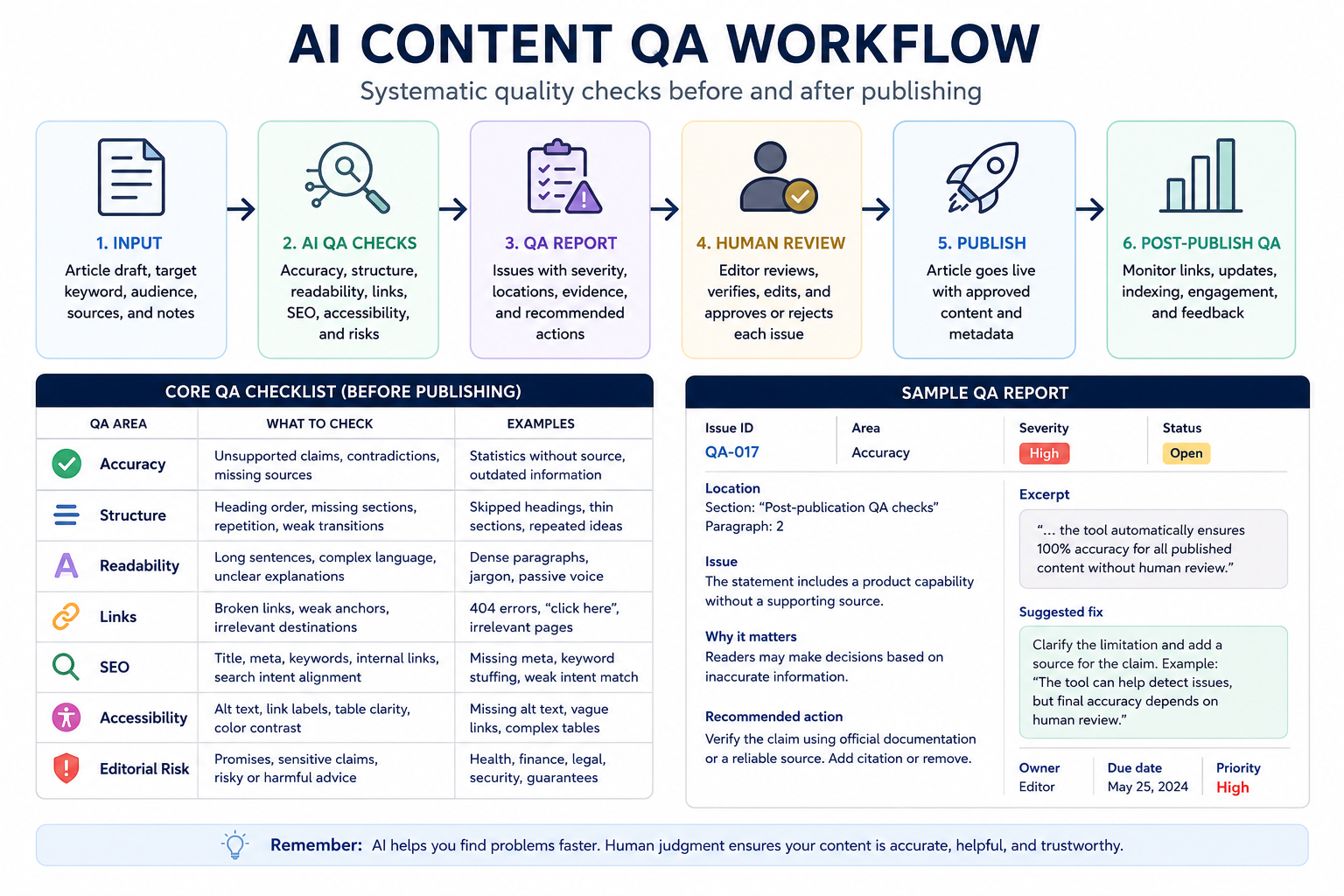
Publishing an article is not the end of the content process. Links can break, facts can become outdated, headings can lose their structure, and last-minute edits can introduce errors. An AI content QA workflow helps editors detect these problems consistently before and after publication.
The goal is not to let AI decide whether an article is trustworthy. The goal is to use AI for fast, structured inspection while a human editor remains responsible for factual accuracy, judgment, and the final publishing decision.
What an AI content QA workflow should check
A useful QA workflow separates checks that can be automated from decisions that still require editorial judgment.
| QA area | What AI can inspect | What a human must decide |
|---|---|---|
| Accuracy | Unsupported claims, contradictions, vague statistics, missing sources | Whether the claim is correct and supported by a reliable source |
| Structure | Heading order, missing sections, repeated ideas, weak transitions | Whether the article answers the reader’s real question |
| Readability | Long sentences, dense paragraphs, unclear language, repetition | Whether the tone is natural and appropriate for the audience |
| Links | Missing links, suspicious anchors, repeated destinations | Whether each source is trustworthy and contextually relevant |
| SEO | Title, description, heading use, keyword placement, internal links | Whether the content satisfies search intent without over-optimization |
| Accessibility | Missing alt text, unclear link labels, overly complex tables | Whether the page is understandable without relying only on visuals |
| Editorial risk | Promises, sensitive claims, strong recommendations, risky wording | Whether the content should be revised, escalated, or removed |
Pre-publication QA checks
1. Confirm the article matches its title
The title creates an expectation. The article should deliver that outcome directly. If the title promises a workflow, the content should include steps, inputs, outputs, review points, and a practical example rather than only explaining the topic.
2. Review every factual claim
Mark claims involving statistics, product capabilities, laws, pricing, dates, security, health, finance, or technical specifications. These claims should be verified against reliable and current sources. AI may help identify claims, but it should not be treated as the source of truth.
3. Check heading structure
The article title should be the main page heading. Major sections should use H2 headings, with H3 headings nested beneath them. Skipping levels or using headings only for visual styling can make the article harder to scan and understand.
4. Inspect links
Check that every internal and external link points to the intended destination. Anchor text should explain what the reader will find. Avoid repeated generic anchors such as “click here” when a descriptive phrase would be clearer.
5. Remove repetition and template language
AI-assisted drafts often repeat the same transitions, warnings, and summary statements. A QA pass should identify paragraphs that restate earlier sections without adding new information.
6. Review SEO elements
- The SEO title accurately represents the article.
- The meta description explains the practical benefit.
- The focus keyword appears naturally in important locations.
- The slug is short and readable.
- Relevant internal links are included.
- The article avoids unnatural keyword repetition.
7. Check the featured image and alt text
The image should support the topic rather than serve as decoration only. Alt text should describe the image’s purpose in context. It should not be filled with unrelated keywords.
Post-publication QA checks
Some problems only appear after the page is live. A second QA stage should run after publication.
- Open the page on desktop and mobile.
- Confirm the title, image, tables, code blocks, and lists display correctly.
- Click every important internal and external link.
- Check that the page is indexable when it should be.
- Confirm the canonical URL points to the intended page.
- Review the social preview image and description.
- Check that the page loads without broken blocks or missing media.
- Revisit the article when facts, tools, prices, or recommendations change.
How to build the AI content QA workflow
Step 1: Define the input
The workflow should receive the article title, draft content, target audience, focus keyword, intended search intent, internal link targets, and any source material used during writing.
Step 2: Run separate QA passes
Do not ask the AI to evaluate everything in one vague request. Use separate passes for factual claims, structure, readability, links, SEO, and editorial risk. Focused checks produce clearer and more useful results.
Step 3: Require evidence for every issue
The QA report should quote or identify the exact sentence, heading, or link that caused the warning. A general statement such as “the article could be clearer” is not actionable.
Step 4: Assign severity
Use a simple severity system so editors know what must be fixed before publication.
- Critical: Incorrect, unsafe, misleading, legally risky, or privacy-sensitive content.
- High: Unsupported claims, broken essential links, or content that fails the article’s main promise.
- Medium: Weak structure, unclear explanations, missing internal links, or poor metadata.
- Low: Minor style, consistency, or formatting improvements.
Step 5: Route the report to a human editor
The AI should produce findings, not final approval. An editor should accept, reject, or revise each recommendation and record the final decision.
Step 6: Save recurring findings
Track common problems such as repeated introductions, unsupported claims, weak internal linking, or missing alt text. These patterns can be converted into stronger templates and editorial rules.
Recommended QA report format
| Field | Example |
|---|---|
| Issue ID | QA-004 |
| Area | Accuracy |
| Severity | High |
| Location | Paragraph under “Post-publication checks” |
| Issue | The statement includes a product capability without a source. |
| Recommended action | Verify the claim against official documentation or remove it. |
| Owner | Editor |
| Status | Open |
Copy-and-use prompts
Pre-publication QA prompt
You are reviewing an article before publication.

Article title:
[TITLE]

Target reader:
[AUDIENCE]

Primary topic:
[TOPIC]

Focus keyword:
[KEYWORD]

Intended outcome:
[WHAT THE READER SHOULD BE ABLE TO DO]

Review the article for:
1. Unsupported or unverifiable claims
2. Contradictions
3. Missing explanations
4. Repeated ideas
5. Heading structure
6. Readability
7. Internal linking opportunities
8. Weak or misleading anchor text
9. SEO title and meta description alignment
10. Accessibility issues
11. Statements that require specialist review

For every issue, return:
- Severity: critical, high, medium, or low
- Exact location
- Problem
- Why it matters
- Recommended correction
- Whether human verification is required

Do not rewrite the full article. Produce an actionable QA report.

Article:
[PASTE ARTICLE]
Final editorial review prompt
Review this article as a skeptical human editor.

Confirm whether it:
- Delivers what the title promises
- Gives the reader practical value
- Contains original topic-specific explanations
- Avoids generic AI-generated template language
- Uses accurate and natural English
- Clearly separates facts from recommendations
- Includes appropriate human review warnings
- Has useful internal and external links
- Is ready to publish without misleading the reader

Return:
1. Publish decision: ready, minor revision, major revision, or do not publish
2. Blocking issues
3. Important improvements
4. Optional refinements
5. A final five-point publishing checklist

Article:
[PASTE ARTICLE]
Content QA checklist
- The article fulfills the promise made by its title.
- Important factual claims have been verified.
- Headings follow a logical hierarchy.
- Repeated and generic paragraphs have been removed.
- Internal links are relevant and useful.
- External sources are trustworthy and current.
- The SEO title and meta description match the content.
- The featured image and alt text are appropriate.
- The page has been checked on mobile and desktop.
- A human editor has approved the final version.
Final guidance
An AI content QA workflow is most useful when it makes editorial review faster and more consistent. It should highlight possible problems, show exactly where they appear, and help the editor prioritize corrections.
Do not optimize only for a plugin score. A high-quality article should be accurate, useful, readable, specific to its topic, and reviewed by a person who understands the audience.
Where to go next
Explore Writoria’s AI Workflow Guides, use the practical resources in AI Templates and SOPs, review AI Automation Guides, and continue with the guide to building an AI internal linking workflow.