
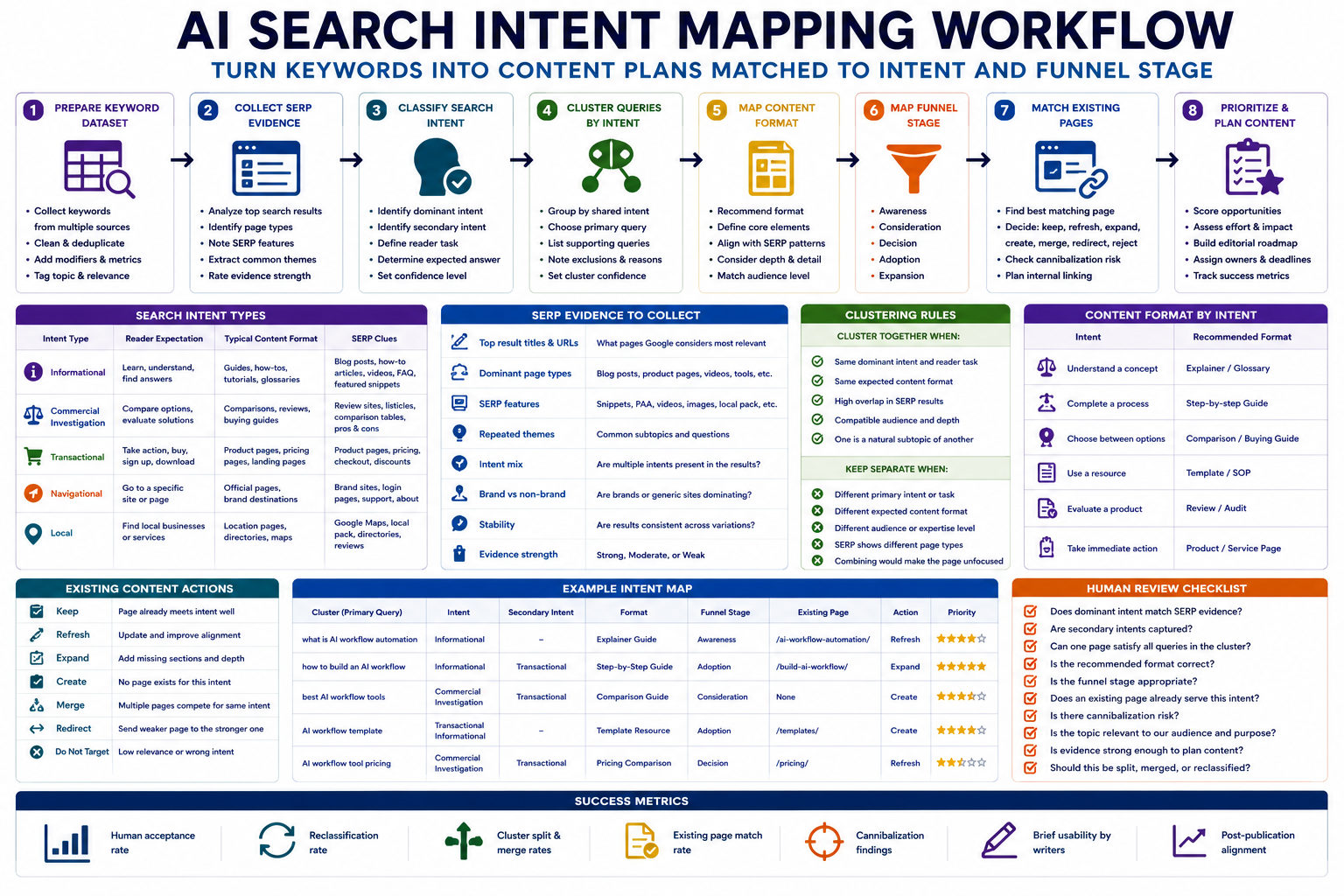
Keywords that look similar do not always represent the same reader expectation. One person may want a definition, another may want a step-by-step process, and another may be comparing tools before buying. An AI search intent mapping workflow helps SEO teams organize these differences before creating or updating content.
The goal is not to classify every keyword using a single label and publish one article for each phrase. The goal is to combine keyword data, search-result evidence, existing content, and human judgment to decide which queries belong together, what page format they require, and where they fit within the reader journey.
What search intent means in content planning
Search intent describes the outcome a person expects after entering a query. It is not determined only by the words used. Context, modifiers, search results, product familiarity, and the reader’s stage of awareness all affect the expected answer.
| Intent type | Reader expectation | Typical content format |
|---|---|---|
| Informational | Understand a concept, problem, or process | Guide, explanation, tutorial, glossary |
| Commercial investigation | Compare approaches, products, or providers | Comparison, alternatives, review, buying guide |
| Transactional | Complete an action, purchase, sign up, or download | Product page, service page, pricing page, template |
| Navigational | Reach a known website, brand, product, or page | Official page or branded destination |
| Local | Find a nearby business, service, or location | Location page, directory, map result |
These labels are useful, but many queries contain mixed intent. A search such as “best AI automation tools for small teams” is informational and commercial. The workflow should identify the dominant expectation without hiding meaningful secondary intent.
Step 1: Prepare the keyword dataset
Begin with a structured list rather than a loose collection of phrases. Remove obvious duplicates, preserve meaningful modifiers, and keep the original source of each keyword.
| Field | Purpose |
|---|---|
| Keyword | The exact search phrase under review |
| Topic | The broader subject or product area |
| Modifier | Words such as how, best, template, pricing, review, or alternative |
| Search volume | A directional demand estimate, not a quality judgment |
| Current ranking URL | The existing page associated with the query |
| Business relevance | How closely the query supports the site’s purpose |
| Source | Search Console, keyword tool, customer language, or editorial research |
| Notes | Ambiguity, seasonality, region, language, or brand context |
Do not remove low-volume phrases automatically. A specific query with clear business relevance may deserve more attention than a broad phrase with higher estimated volume.
Preserve intent-changing modifiers
Modifiers often reveal the expected content type:
- What is: Definition or explanation
- How to: Step-by-step process
- Template: Reusable resource or example
- Best: Comparison or selection help
- Versus: Direct comparison
- Alternatives: Replacement options
- Pricing: Cost and plan information
- Review: Evaluation and evidence
- For beginners: Simpler depth and vocabulary
- For agencies: Role-specific application
Step 2: Collect search-result evidence
AI should not classify intent from the keyword alone when current search results are available. Search-result pages reveal what format and interpretation search engines currently associate with the query.
For each important keyword, record:
- Titles and page types appearing in the leading results
- Whether results are guides, product pages, comparisons, videos, tools, or category pages
- Repeated subtopics and questions
- Presence of featured snippets, videos, shopping results, forums, or local results
- Whether brands or general educational sites dominate
- Whether several different intent types appear together
- Whether the results appear stable or unusually mixed
Use the search results as evidence, not as an instruction to copy existing pages. The purpose is to understand reader expectations and format patterns.
Use an evidence strength label
- Strong: Most leading results use the same page type and answer pattern.
- Moderate: One intent dominates, but meaningful alternatives appear.
- Weak: Results are highly mixed or the query is ambiguous.
Weak-evidence keywords should receive human review before they are added to a content plan.
Step 3: Classify dominant and secondary intent
Each keyword record should contain more than one broad label. Capture the expected task, desired answer, and likely format.
| Field | Example |
|---|---|
| Dominant intent | Informational |
| Secondary intent | Commercial investigation |
| Reader task | Understand how to evaluate AI tools before purchase |
| Expected answer | A practical audit process and checklist |
| Preferred format | Step-by-step guide |
| Evidence strength | Strong |
| Confidence | High |
Do not confuse the business goal with the searcher’s goal. A company may want a visitor to buy a product, but a searcher asking “what is workflow automation” still expects an educational answer first.
Step 4: Cluster queries by shared reader expectation
Keyword similarity alone is not enough for clustering. Two phrases should share a page only when one page can satisfy both without becoming unfocused.
Use the following clustering signals:
- Same dominant intent
- Same expected content format
- Same reader task
- Substantial overlap in search-result pages
- Compatible level of detail
- Compatible audience
- One phrase is a natural subtopic of the other
Separate queries when:
- One expects a definition and another expects a comparison.
- One is aimed at beginners and another at technical specialists.
- One expects a downloadable template and another expects a general guide.
- One focuses on a specific product and another on the broader category.
- The search results show clearly different page types.
- Combining them would force the article to serve unrelated tasks.
Choose a primary query for each cluster
The primary query should best represent the cluster’s reader expectation and content purpose. It should not be selected using search volume alone.
Record:
- Primary query
- Supporting queries
- Shared intent
- Shared page format
- Questions that need dedicated sections
- Queries excluded from the cluster
- Reason for each exclusion
Step 5: Map intent to content format
The content format should follow the task implied by the query and supported by search-result evidence.
| Reader expectation | Recommended format | Core elements |
|---|---|---|
| Understand a concept | Explainer or glossary page | Definition, examples, boundaries, related terms |
| Complete a process | Step-by-step guide | Inputs, stages, examples, checklist, failure cases |
| Choose between options | Comparison or buying guide | Criteria, evidence, trade-offs, recommendations |
| Use a reusable resource | Template or SOP page | Copyable resource, instructions, example, review rules |
| Evaluate a product | Review or audit | Use case, testing method, limitations, pricing, fit |
| Take immediate action | Product, service, or signup page | Offer, proof, conditions, pricing, action |
A query may justify more than one page only when the user tasks are genuinely different. Creating several pages with minor wording changes increases the risk of overlap and cannibalization.
Step 6: Map each cluster to a funnel stage
Funnel stage is not identical to search intent, but it helps connect content with the reader journey.
- Awareness: The reader is learning about a problem or concept.
- Consideration: The reader is comparing methods, tools, or solutions.
- Decision: The reader is evaluating a specific option or preparing to act.
- Adoption: The reader needs setup, implementation, or operating guidance.
- Expansion: The reader wants to improve, scale, or govern an existing system.
A funnel label should never override the actual query evidence. It is an editorial planning field, not proof of intent.
Step 7: Match clusters to existing content
Before creating a new page, compare the cluster with the site’s current inventory.
| Decision | When to use it |
|---|---|
| Keep | An existing page already satisfies the intent well |
| Refresh | The correct page exists but needs stronger alignment or coverage |
| Expand | The page needs additional sections for supporting queries |
| Create | No existing page satisfies the cluster |
| Merge | Several weak pages compete for the same intent |
| Redirect | A retired or duplicate page should point to the stronger destination |
| Do not target | The query has weak business relevance or unsuitable intent |
Check for cannibalization
Potential cannibalization exists when multiple pages target the same reader task and compete without a clear role. Review:
- Pages ranking for the same query group
- Pages with similar titles and introductions
- Pages using the same primary intent and format
- Pages that repeatedly replace each other in search results
- Pages with overlapping internal anchor text
Not every keyword overlap is a problem. Two pages may mention the same topic while serving different user tasks. Intent and page purpose should determine whether consolidation is necessary.
Step 8: Assign content priority
Prioritize clusters using a combination of reader value, business relevance, evidence strength, content gap, and execution effort.
| Factor | Question |
|---|---|
| Business relevance | Does the topic support the site’s core purpose? |
| Reader value | Can the content help someone complete a meaningful task? |
| Intent clarity | Is the expected answer supported by strong evidence? |
| Existing opportunity | Does the site already have a page that can be improved? |
| Authority fit | Can the site produce credible and useful content on this topic? |
| Effort | How much research, expertise, design, or development is required? |
| Risk | Could inaccurate or weak content create harm or reputational problems? |
Example search intent map
Assume a site is planning content about AI workflow software.
| Keyword cluster | Dominant intent | Expected format | Funnel stage | Content action |
|---|---|---|---|---|
| what is AI workflow automation, AI workflow explained | Informational | Explainer guide | Awareness | Create |
| how to build an AI workflow, AI workflow steps | Informational | Step-by-step tutorial | Adoption | Refresh existing guide |
| best AI workflow tools, AI automation tools comparison | Commercial investigation | Comparison guide | Consideration | Create separate page |
| AI workflow template, AI automation SOP template | Transactional-informational | Template resource | Adoption | Add to template hub |
| AI workflow tool pricing | Commercial investigation | Pricing comparison | Decision | Research before targeting |
These clusters should not be combined into one page. They share a topic but represent different tasks and expected formats.
Step 9: Review AI classifications manually
AI can classify and group queries quickly, but an SEO strategist should review ambiguous and high-priority clusters.
- Does the dominant intent match current search-result evidence?
- Are meaningful secondary intents recorded?
- Can one page satisfy every keyword in the cluster?
- Was clustering based only on similar wording?
- Does the recommended format match the expected task?
- Does an existing page already serve the intent?
- Would creating a new page cause overlap?
- Is the topic genuinely relevant to the site?
- Are region, language, device, or audience differences important?
- Is the evidence strong enough for publication planning?
Measure the quality of the intent map
Do not judge the workflow only by how many keywords it processes. Measure whether the resulting content plan is accurate and usable.
- Human acceptance rate: Percentage of classifications approved.
- Reclassification rate: Percentage whose intent or format changes during review.
- Cluster split rate: How often AI groups unrelated tasks together.
- Cluster merge rate: How often AI separates queries that one page could serve.
- Existing-page match rate: How often the workflow identifies the correct current page.
- Cannibalization findings: Number of overlapping pages discovered.
- Brief usability: Whether writers can create a focused brief from the map.
- Post-publication alignment: Whether the page later ranks for queries consistent with the intended cluster.
Copy-and-use prompts
Search intent classification prompt
You are helping me classify search intent for SEO content planning.

Website topic:
[SITE TOPIC]

Target audience:
[AUDIENCE]

Keyword:
[KEYWORD]

Keyword modifiers:
[MODIFIERS]

Search-result evidence:
[PASTE RESULT TITLES, PAGE TYPES, FEATURES, AND REPEATED THEMES]

Existing ranking URL:
[URL OR NONE]

Return:

1. Dominant intent
2. Secondary intent
3. Reader task
4. Expected answer
5. Recommended content format
6. Funnel stage
7. Search-result evidence supporting the classification
8. Evidence strength: strong, moderate, or weak
9. Confidence: high, medium, or low
10. Ambiguities requiring human review

Do not classify from the keyword alone when search-result evidence is provided.
Do not confuse our business goal with the searcher’s goal.
Keyword clustering prompt
Group these keywords into content clusters based on shared reader expectation.

Keywords and intent records:
[PASTE KEYWORDS, INTENT, FORMAT, AUDIENCE, AND SERP EVIDENCE]

For each cluster, return:

1. Cluster name
2. Primary query
3. Supporting queries
4. Dominant intent
5. Secondary intent
6. Reader task
7. Recommended page format
8. Required sections
9. Queries that should be excluded
10. Reason for each exclusion
11. Confidence level
12. Human review note

Rules:
- Do not cluster using wording similarity alone
- Separate keywords with different expected formats
- Separate different audiences when one page cannot serve both
- Keep one cluster only when a single page can satisfy every included query
- Mark mixed or ambiguous clusters for review
Existing-content mapping prompt
Map these approved keyword clusters to the existing content inventory.

Keyword clusters:
[PASTE CLUSTERS]

Existing content inventory:
[PASTE TITLES, URLS, SUMMARIES, INTENT, FORMAT, AND CURRENT TARGET QUERIES]

For each cluster, recommend:

- Keep existing page
- Refresh existing page
- Expand existing page
- Create new page
- Merge overlapping pages
- Redirect a weaker page
- Do not target

Return:
1. Cluster
2. Recommended action
3. Existing page or proposed new page
4. Reason
5. Intent match
6. Format match
7. Cannibalization risk
8. Sections to add or preserve
9. Internal linking implications
10. Human review required

Do not recommend a new page when an existing page already satisfies the same reader task.
Intent-map quality review prompt
Review this search intent map as an experienced SEO strategist.

Intent map:
[PASTE MAP]

Check for:

1. Intent classifications based only on wording
2. Missing search-result evidence
3. Mixed intents hidden inside one cluster
4. Similar queries split unnecessarily
5. Incorrect page formats
6. Funnel stages overriding actual intent
7. Existing pages ignored
8. Potential keyword cannibalization
9. Low-relevance topics included only for volume
10. Weak-confidence decisions treated as final

Return:
- Approved clusters
- Clusters to split
- Clusters to merge
- Intent classifications to revise
- Existing-page mapping changes
- Cannibalization concerns
- Missing evidence
- Final editorial checklist

Do not approve a cluster merely because its keywords share the same main noun.
AI search intent mapping checklist
- The keyword dataset preserves meaningful modifiers.
- Search-result evidence is collected for important queries.
- Dominant and secondary intent are recorded separately.
- The reader’s expected task is written in plain language.
- Content format follows intent and search-result evidence.
- Evidence strength and confidence are recorded.
- Queries are clustered by shared task, not wording alone.
- One page can realistically satisfy every query in each cluster.
- Excluded queries and reasons are documented.
- Primary queries represent the cluster rather than only the highest volume.
- Funnel stage does not override actual search intent.
- Clusters are compared with the existing content inventory.
- Potential cannibalization is reviewed.
- Low-confidence and mixed-intent clusters receive human review.
- Content actions are recorded as keep, refresh, expand, create, merge, redirect, or reject.
Common mistakes to avoid
- Classifying from the keyword alone: Use search-result evidence.
- Using one intent label only: Record meaningful secondary intent.
- Clustering by shared words: Group by shared reader task.
- Combining every query into one guide: Separate incompatible formats.
- Ignoring existing content: Refresh or merge before creating new pages.
- Using funnel stage as intent: Treat it as a planning field.
- Prioritizing volume alone: Include relevance, authority, and reader value.
- Accepting AI confidence blindly: Review ambiguous and important clusters.
Final guidance
A dependable AI search intent mapping workflow turns keyword research into a content architecture rather than a list of phrases. It explains what the reader expects, which queries belong together, what format should satisfy them, and whether an existing page can already do the job.
Use AI to process large datasets and surface patterns, but keep current search-result evidence and human editorial judgment at the center of the workflow. The strongest map produces fewer, clearer, and more purposeful pages.
Related guides
- Build an AI Internal Linking Workflow for SEO Blogs
- Build an AI Content Refresh Workflow for Old Articles
- Browse Practical AI Workflow Guides
- Explore Writoria’s AI Automation Guides