
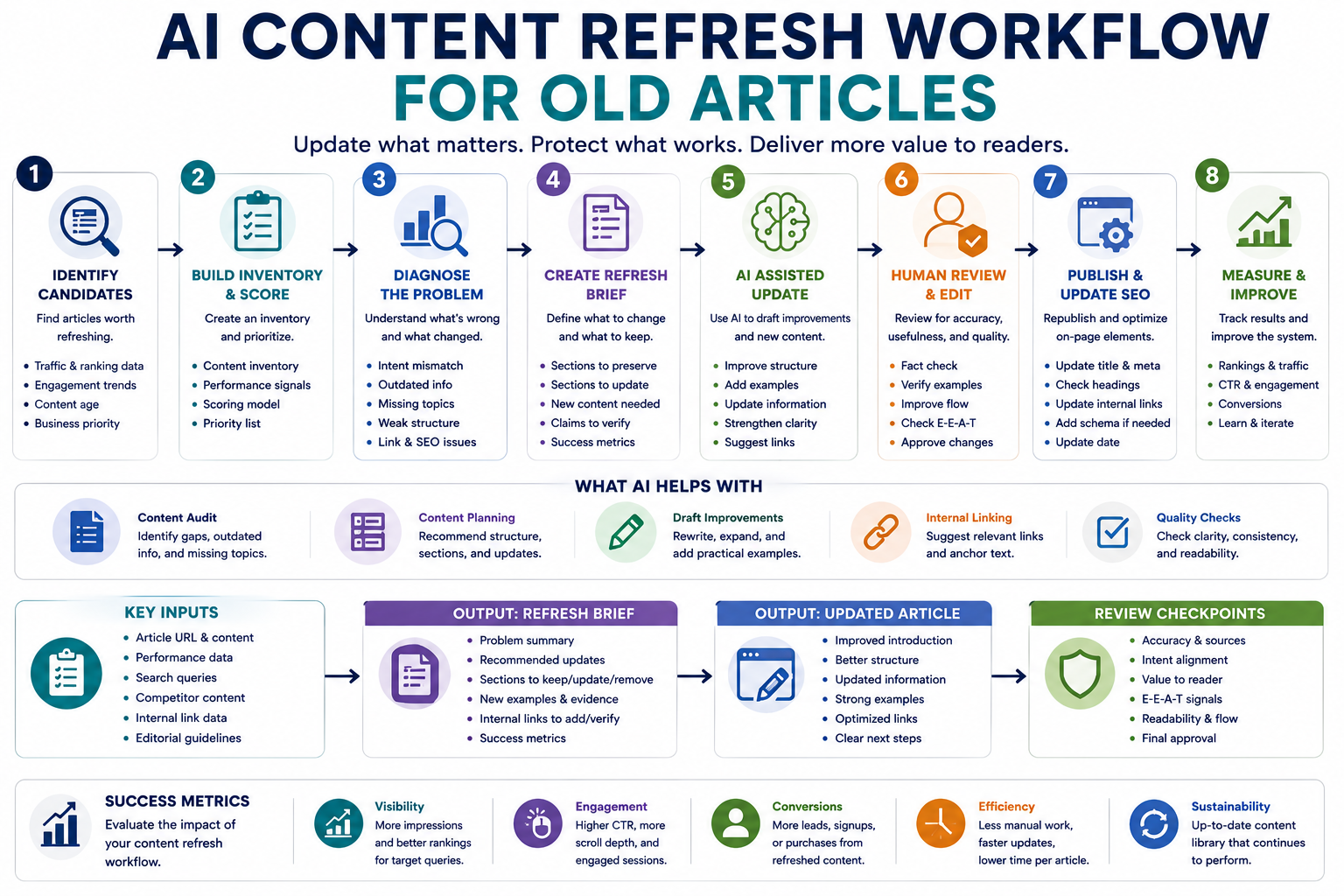
Old articles do not always need a complete rewrite. Some need updated facts, stronger examples, clearer structure, repaired links, or better alignment with the reader’s current search intent. An AI content refresh workflow helps content teams identify what changed, prepare a focused update brief, and review the revised article without replacing useful sections unnecessarily.
The goal is not to ask AI to rewrite every declining page. The goal is to combine performance data, content evidence, editorial judgment, and controlled AI assistance so each article receives the smallest update that meaningfully improves its usefulness and accuracy.
When an old article should be refreshed
Age alone is not a reason to update an article. A page should enter the refresh workflow when there is evidence that its usefulness, accuracy, visibility, or reader experience can be improved.
- Important facts, screenshots, prices, features, or recommendations are outdated.
- Search impressions remain strong but clicks are declining.
- The page ranks below its previous position for important queries.
- The article receives traffic but has weak engagement or poor task completion.
- Newer articles cover parts of the topic more clearly.
- The introduction no longer matches current search intent.
- Internal links point to old, redirected, or irrelevant pages.
- Examples are too generic to help the reader apply the advice.
- The article contains repeated template language or unsupported claims.
- A stronger competing page has changed what readers expect from the topic.
Do not refresh a page only because a tool marks it as old. Some evergreen articles continue to perform well and require only a factual check.
Step 1: Build a refresh inventory
Create a working inventory of published articles that may need attention. The inventory should combine editorial information with performance signals.
| Field | Purpose |
|---|---|
| Article title | Identifies the page under review. |
| URL | Provides the canonical destination. |
| Original publish date | Shows how long the article has been live. |
| Last substantial update | Distinguishes real revisions from minor edits. |
| Primary topic | Groups related articles and possible overlaps. |
| Search intent | Clarifies the reader’s expected outcome. |
| Performance trend | Records whether traffic, impressions, clicks, or rankings are rising or falling. |
| Known issues | Lists outdated facts, broken links, weak structure, or missing sections. |
| Business priority | Marks strategically important pages. |
| Refresh status | Tracks review, revision, approval, and publication. |
The inventory should help the team choose articles based on evidence rather than update them in random order.
Step 2: Prioritize articles with a simple scoring model
Score each candidate from 1 to 5 across a small set of factors. A page with high business value and clear fixable problems should usually be refreshed before a low-value page with uncertain potential.
| Factor | Low score | High score |
|---|---|---|
| Business value | Little strategic importance | Supports an important topic, product, or reader journey |
| Traffic opportunity | Very limited visibility | Strong impressions or previous traffic |
| Content decay | Still accurate and useful | Clearly outdated or incomplete |
| Update effort | Requires a complete rebuild | Can be improved with focused changes |
| Reader impact | Minor convenience improvement | Fixes misleading or confusing guidance |
Do not use the score as an automatic publishing decision. It is a prioritization aid that still requires editorial review.
Step 3: Diagnose the article before rewriting it
The most important part of a refresh workflow is identifying the actual problem. A falling page does not always need more words. It may need a clearer opening, more accurate examples, stronger internal links, or a better match with search intent.
Review the article across the following areas:
| Review area | Questions to ask |
|---|---|
| Intent | Does the page still answer the main reason people search for this topic? |
| Accuracy | Are facts, dates, product capabilities, processes, and examples current? |
| Completeness | Are important reader questions or workflow stages missing? |
| Structure | Can a reader scan the page and understand the sequence? |
| Originality | Does the article provide topic-specific insight or generic template language? |
| Examples | Do the examples show how the advice works in practice? |
| Links | Are internal and external links relevant, live, and useful? |
| SEO elements | Do the title, description, headings, and page content still align? |
| Reader experience | Are paragraphs, tables, lists, and calls to action easy to use? |
Separate evidence from assumptions
AI can identify possible weaknesses, but it should not claim that a section caused a traffic decline unless performance data supports that conclusion. The workflow should label each finding as:
- Confirmed issue: Supported by the article, analytics, broken-link checks, or source review.
- Likely issue: Strong editorial evidence exists, but direct performance impact is unknown.
- Hypothesis: Requires testing or further investigation.
Step 4: Create a focused refresh brief
The refresh brief should explain what must change and what should remain untouched. This prevents an AI tool or writer from replacing valuable sections simply because a rewrite is easier than a careful edit.
A useful brief contains:
- Article title and URL
- Current search intent
- Target reader
- Reason for refresh
- Confirmed problems
- Sections to preserve
- Sections to update
- Sections to remove or merge
- New examples or evidence required
- Internal links to add or verify
- Claims requiring source verification
- SEO title or description changes
- Human reviewer
- Success metrics
Example refresh brief
| Brief field | Example |
|---|---|
| Reason for refresh | The article contains generic guidance and does not show a complete workflow. |
| Preserve | The original definition and two accurate examples. |
| Update | The introduction, step sequence, checklist, and internal links. |
| Add | A prioritization table, a structured brief template, and a review prompt. |
| Remove | Repeated paragraphs that explain generic workflow principles. |
| Verify | Product features, dates, external recommendations, and linked resources. |
| Success metric | Improved editorial usefulness, stable indexing, and lower revision time. |
Step 5: Update the article in controlled passes
Do not request one complete rewrite before reviewing the article’s strongest and weakest sections. Use separate update passes so changes remain understandable.
Pass 1: Correct factual problems
Update or remove outdated claims, statistics, tool descriptions, screenshots, prices, dates, and recommendations. Verify important changes against reliable current sources.
Pass 2: Improve search-intent alignment
Compare the title and introduction with what the article actually delivers. A workflow article should provide a usable process, not only a definition or tool list.
Pass 3: Improve structure
Organize the article into a logical sequence. Remove repeated explanations, combine overlapping sections, and make headings describe the reader’s next action.
Pass 4: Add practical value
Add examples, tables, decision rules, templates, prompts, and checklists only where they help the reader apply the guidance. Avoid increasing length without increasing usefulness.
Pass 5: Repair the linking structure
Check internal and external links. Replace outdated destinations, add useful newer resources, and remove links that no longer support the article.
Pass 6: Review metadata and presentation
Confirm that the SEO title, meta description, slug, featured image, alt text, headings, tables, lists, and mobile layout still match the refreshed content.
Step 6: Protect what already works
A refresh can damage a useful page when the team changes too much without evidence. Protect valuable elements before editing.
- Keep the existing URL unless there is a strong technical reason to change it.
- Preserve accurate sections that continue to serve the reader.
- Record the original title, description, headings, and important links.
- Do not remove a useful section only because it is old.
- Do not replace specific examples with broader AI-generated summaries.
- Check whether external pages link to a section or concept that may be removed.
- Keep a revision history or backup before major changes.
- Avoid changing the page topic while keeping the same URL.
Use change-risk levels
- Low risk: Correcting grammar, repairing links, updating a date, or improving formatting.
- Medium risk: Rewriting the introduction, adding sections, changing headings, or updating examples.
- High risk: Changing search intent, removing major sections, replacing most of the article, or changing the URL.
High-risk changes should receive stronger editorial review and closer performance monitoring after publication.
Step 7: Run a human quality review
AI can prepare findings and drafts, but a human editor should approve the final article. The reviewer should compare the refreshed version with both the update brief and the original page.
- The article still fulfills the promise made by its title.
- Important existing value has not been removed accidentally.
- Facts, dates, products, and recommendations have been verified.
- New examples are accurate and relevant.
- Repeated or generic passages have been removed.
- Headings follow a logical order.
- Internal links point to the strongest available pages.
- External links use reliable and current sources.
- The introduction matches current search intent.
- The page is useful without unnecessary keyword repetition.
- The refreshed content has been checked on desktop and mobile.
Step 8: Measure the refresh after publication
Do not judge the refresh immediately after publishing. Search visibility and reader behavior may take time to change. Record the publication date and compare results across a consistent review period.
- Impressions: Whether the page appears for more or fewer relevant searches.
- Clicks: Whether search visits improve after the update.
- Click-through rate: Whether the title and description better match expectations.
- Ranking distribution: Whether important queries improve, decline, or change intent.
- Engagement: Whether readers continue further into the article or related pages.
- Internal link activity: Whether readers use newly added links.
- Conversion or completion: Whether the article helps readers take the intended next step.
- Editorial effort: How much time the refresh required.
Record unexpected declines rather than immediately making another large rewrite. First confirm indexing, technical health, search-intent alignment, and whether the change affected valuable sections.
Copy-and-use prompts
Content refresh audit prompt
You are auditing an existing article before a content refresh.

Article title:
[TITLE]

URL:
[URL]

Target audience:
[AUDIENCE]

Primary topic:
[TOPIC]

Current search intent:
[INTENT]

Known performance information:
[PASTE IMPRESSIONS, CLICKS, RANKING TRENDS, OR WRITE UNKNOWN]

Current article:
[PASTE ARTICLE]

Review the article for:
1. Outdated or unverifiable information
2. Search-intent mismatch
3. Missing reader questions
4. Weak structure
5. Repeated or generic language
6. Thin examples
7. Broken or outdated links
8. Missing internal link opportunities
9. SEO title and description mismatch
10. Sections that should be preserved

For every finding, return:
- Area
- Exact location
- Issue
- Evidence
- Status: confirmed issue, likely issue, or hypothesis
- Recommended action
- Change risk: low, medium, or high
- Human verification required: yes or no

Do not rewrite the article.
Do not claim that a content issue caused a ranking decline without evidence.
Refresh brief prompt
Create a focused content refresh brief.

Article:
[PASTE ARTICLE]

Audit findings:
[PASTE FINDINGS]

Target audience:
[AUDIENCE]

Search intent:
[INTENT]

Business goal:
[GOAL]

Internal pages available:
[LIST RELEVANT TITLES AND URLS]

Return:

1. Reason for refresh
2. Reader outcome
3. Sections to preserve
4. Sections to update
5. Sections to remove or merge
6. New sections required
7. Facts and claims requiring verification
8. Examples or evidence required
9. Internal links to add or check
10. SEO title and meta description recommendation
11. Change-risk level
12. Human review checkpoints
13. Post-publication success metrics

Use the smallest useful update.
Do not recommend a full rewrite unless the evidence clearly requires it.
Refreshed article review prompt
Review this refreshed article against the original and the approved refresh brief.

Original article:
[PASTE ORIGINAL]

Refresh brief:
[PASTE BRIEF]

Refreshed article:
[PASTE UPDATED VERSION]

Check whether:
1. The refresh brief was followed
2. Valuable original sections were preserved
3. Unsupported claims were added
4. Search intent changed unintentionally
5. Important facts were verified
6. New examples are specific and useful
7. Internal links are relevant
8. Repetition was reduced
9. The title and metadata still match
10. Any high-risk changes require additional review

Return:
- Publish decision: ready, minor revision, major revision, or do not publish
- Blocking issues
- Important corrections
- Valuable original content that was lost
- Unsupported additions
- Final publishing checklist
AI content refresh workflow checklist
- The article was selected using evidence rather than age alone.
- The original article was saved before editing.
- Performance and editorial problems were reviewed separately.
- Findings were labeled as confirmed, likely, or hypothetical.
- The refresh brief states what to preserve and what to change.
- The URL remains unchanged unless a strong reason exists.
- Outdated claims and links have been verified.
- Generic content has been replaced with topic-specific value.
- New examples and recommendations have been reviewed by a person.
- Internal links support the reader’s next step.
- Metadata and featured media match the refreshed article.
- The page was checked on desktop and mobile.
- The publication date and major changes were recorded.
- Post-refresh results will be reviewed after a consistent period.
Common mistakes to avoid
- Refreshing by age alone: Use evidence of content or performance problems.
- Rewriting everything: Preserve accurate sections that still work.
- Adding words without value: Improve usefulness, not only length.
- Changing the URL unnecessarily: Protect continuity and existing links.
- Trusting AI-generated facts: Verify important claims independently.
- Changing search intent accidentally: Keep the reader’s original task clear.
- Removing valuable examples: Compare the refreshed article with the original.
- Measuring too early: Allow enough time for meaningful comparison.
Final guidance
A dependable AI content refresh workflow does not replace the article with a new generic draft. It identifies the specific reasons an existing page needs attention, protects the useful parts, and produces a controlled set of changes that an editor can verify.
Start with a small group of high-value articles. Diagnose each page before editing, create a focused brief, review every important change, and measure the result after publication. This produces more reliable updates than refreshing an entire content library at once.
Related guides
- Build an AI Internal Linking Workflow for SEO Blogs
- Build an AI Content QA Workflow for Published Content
- Browse Practical AI Workflow Guides
- Explore Writoria’s AI Automation Guides